Long before Instagram tutorials and viral hair trends, hairstyling tools quietly shaped the silhouettes that defined fashion eras. From the sculpted finger waves of the 1920s to the glossy blow-outs of the supermodel 1990s, the way hair was dried and styled has always been closely tied to personal identity, social expectation, and cultural expression. As fashion moved away from rigid formality toward greater freedom of self-presentation, the tools used to create those looks evolved alongside it.
What began as a cumbersome salon apparatus gradually transformed into a compact, intelligent device capable of producing everything from soft texture to mirror-like smoothness. Today’s hair dryer represents the culmination of more than a century of collaboration between beauty, technology, and design, one that continues to influence how we present ourselves to the world.
Early Hair Styling Before Modern Technology
Before the widespread use of electricity, hairstyling was a time-consuming ritual, often reserved for those with leisure or domestic help. Hair was typically dried naturally, shaped with heated metal tongs warmed over open flames, or set using damp cloths and rollers left in place for hours or overnight.

During the Victorian and Edwardian periods, elaborate arrangements, chignons, rolls, and tightly controlled waves were outward signals of respectability and social standing. We have a blog post on more Victorian hairstyles. Hairdressing salons did exist by the late nineteenth century, yet without reliable electric tools, stylists relied primarily on manual techniques, patience, and endurance. Fashion illustrations might suggest effortless elegance, but achieving such looks in daily life required significant time and discipline.
The Arrival of the Hair Dryer and a Fashion Revolution
The early twentieth century introduced the first electric hair-drying machines, initially large, stationary devices used in salons.
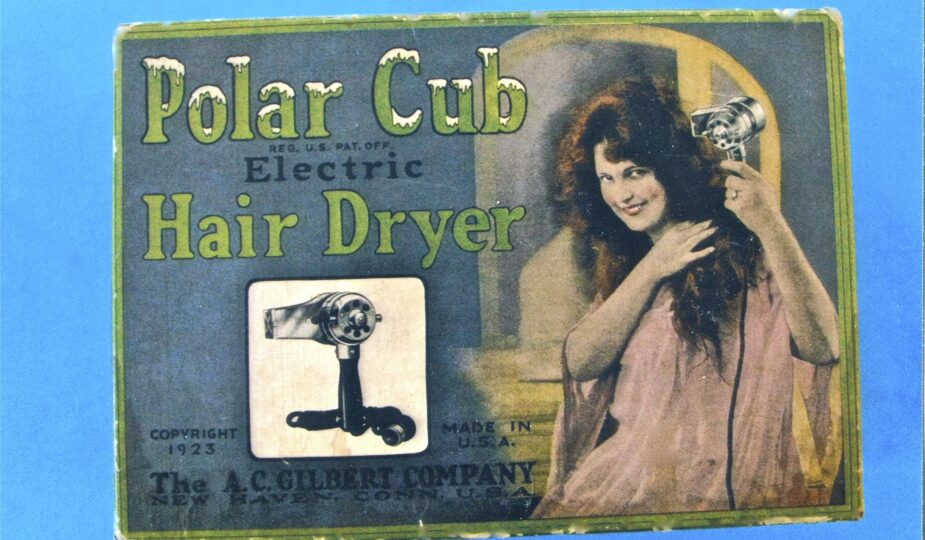
By the 1920s, handheld electric hair dryers began to appear, though they were heavy, noisy, and prone to overheating.
image on the right:‘Sick of Cinderella’ – Mary Pickford before and after she bobbed her hair (Courtesy Birds Eye View)


Despite their limitations, these early tools represented a profound shift. Faster drying times aligned neatly with the modern woman’s changing lifestyle: one that increasingly valued independence, mobility, and efficiency.
Shorter hairstyles, such as the bob, already emerging as symbols of modernity and rebellion, became far easier to maintain and shape with the assistance of electric dryers. Hair was no longer merely arranged; it was deliberately designed to complement a rapidly changing fashion landscape.
Hair Dryers and Iconic Fashion Decades
The 1950s–1960s: Volume, Glamour, and Elegance

Post-war prosperity ushered in an era of polished femininity. Structured garments with cinched waists and full skirts demanded equally considered hairstyles. Bouffants, beehives, and carefully set curls became hallmarks of the period, often achieved under hooded salon dryers that delivered steady, consistent heat.
Hair was sculpted to project poise and refinement, echoing the carefully controlled elegance associated with figures such as Grace Kelly and Brigitte Bardot.
The 1970s–1980s: Freedom, Texture, and Expression


As fashion embraced individuality, hair followed suit. The 1970s favoured softer shapes, such as natural waves, layered shags, and movement, often enhanced through diffused airflow rather than rigid settings. By the 1980s, volume returned with dramatic force. Advances in dryer power and airflow made it possible to achieve the era’s signature fullness, reflecting a broader cultural appetite for visibility, confidence, and excess.
The 1990s–2000s: Minimalism Meets Precision
The supermodel era introduced a paradox of “effortless” beauty that was anything but accidental. Sleek, glossy hair required professional techniques and dependable tools, particularly backstage at fashion shows where time was limited and consistency essential.
As professional technology filtered into domestic use, consumers increasingly sought salon-level results at home, encouraging innovation in motor efficiency, ionic technology, and ergonomic design.
Backstage at Fashion Shows: A Stylist’s Essential Tool
Behind the scenes of runway shows, the hair dryer became an indispensable extension of the stylist’s hand. With multiple models, rapid outfit changes, and strict timelines, its ability to smooth, shape, lift, or cool a style into place proved essential.
Hair worked in concert with clothing: sharp tailoring called for precision, while fluid fabrics demanded softness and movement. In this environment, hairstyling was not secondary to fashion; it was integral to its narrative.
Hair, Technology, and Identity
Throughout the twentieth century, hair remained deeply entwined with cultural movements, from the political symbolism of natural hair in the Civil Rights era to the confrontational aesthetics of punk and later subcultures.
Access to effective styling tools allowed individuals to participate more fully in these visual conversations, whether to conform, resist, or reinterpret prevailing norms. The hair dryer, once a salon luxury, gradually became a commonplace household object—quietly shaping how identity, heritage, and self-expression are presented.
Conclusion
The evolution of the hair dryer mirrors fashion’s own journey from rigid prescription to expressive freedom. It has supported iconic styles, adapted to cultural change, and transformed daily grooming into a creative act. Far from a simple appliance, it remains a silent collaborator in fashion history. In matters of dress, the final impression is never formed by garments alone. It is completed by the hair that frames them.