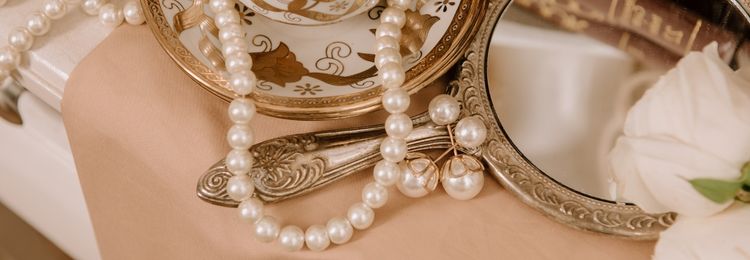
For more than a thousand years, pearl fashion has been woven through the fabric of history. These lustrous gems have never demanded attention through flashy display, yet they command presence through their quiet elegance.
The story of pearls in fashion mirrors the evolution of style itself, transforming from sacred emblems of royalty to bold statements in contemporary streetwear.
Today, the single pearl necklace remains one of the most enduring accessories, elegant enough for formal occasions yet effortless enough for everyday wear.

Pearl Fashion in Renaissance Courts: The Crown Jewel of Royalty
The earliest chapters of pearl fashion were written in the courts of Renaissance Europe, where monarchs draped themselves in layers of these luminous orbs to project divine authority and power. In Elizabethan England, Queen Elizabeth I's portraits immortalized her wearing elaborate pearl adornments. Her dress fabric was white silk satin studded with jewels, including pearls, rubies, and dark stones, all on gold enameled mounts.
Elizabethan dress expert Janet Arnold's research, documented by the Fashion History Timeline at the Fashion Institute of Technology, provides detailed descriptions of these magnificent garments.
Many women at Queen Elizabeth I's court could be seen wearing her cast-offs and others in society strove to emulate her style. The Queen's influence on pearl fashion extended throughout her entire realm.
Several elements of Elizabeth's dress reveal early modern global connections, as the queen was bedecked in hundreds of pearls which covered her dress, hair, necklaces, and the crown that sat behind her.

Until the end of the fifteenth century, most pearls traveling to Europe came from the Persian Gulf, the Red Sea, and the Gulf of Mannar. Following the 'discovery' of the New World, millions of American pearls produced in the Caribbean transformed the global market.
To own pearls was to possess both wealth and moral virtue. In Renaissance England, white represented chastity and purity, which is also a common symbolic interpretation for pearls. For noblewomen, pearls served as social armor. They were proof of lineage, status, and favour at court. In this era, pearls were more than adornment. They were currency in the language of power.
Pearl Fashion Through the Georgian and Victorian Eras
As Europe's aristocracy flourished through the Georgian and Victorian periods, pearl fashion became ever more intricate. The 18th and 19th centuries brought an explosion of craftsmanship with tiaras, chokers, brooches, and drop earrings embellished with pearls and diamonds.
The status and symbolism of pearls only gained strength during the Renaissance. Since the 14th century, pearl jewelry became a fashion item available to anyone who had the means to afford it. This marked a significant democratisation of pearl fashion beyond just the ruling classes.
The healing properties attributed to pearls continued to fascinate the aristocracy. Francis Bacon took crushed pearls mixed in lemon juice as a life-prolonging elixir, demonstrating how pearls held meaning beyond mere decoration.
1920s Pearl Fashion: The Jazz Age and Liberation

When the Roaring Twenties arrived, pearl fashion shed its royal constraints and joined the revolution. For the first time, women wore jewelry on their own terms.
Nothing captured the decade's energy quite like swinging ropes of pearls worn by flappers.
Flapper fashion layered long strands down to the waistline, dancing through the night to jazz rhythms that defied convention.
These were pearls of liberation. The designer Gabrielle 'Coco' Chanel famously revolutionized pearl fashion during this era.
Chanel succeeded in packaging and marketing her own personal attitudes and style, making her a key arbiter of women's taste throughout the twentieth century. In 1926, Vogue published a drawing of a simple, calf-length black dress fashioned from crêpe de Chine with a string of pearls, describing it as 'Chanel's Ford'.
Pavlovich's gifts of Romanov jewels inspired pearl-studded chains hung with crosses. By the end of the 1930s, Chanel was releasing signature necklaces made of dangling, dainty chains intertwined with faux pearls and glittering stones. More layered strings of fake pearls followed, worn proudly by Chanel herself, and a trend was born.
This transformation was complete. Pearl fashion evolved from a symbol of nobility to an emblem of female independence and modern style.
Mid-Century Pearl Fashion and Hollywood Glamour
After World War II, the world craved simplicity and optimism. Pearl fashion once again became the language of elegance, but this time through the polished lens of mid-century Hollywood glamour.
Grace Kelly wore them with quiet poise, Audrey Hepburn made them eternally chic in Breakfast at Tiffany's, and Jackie Kennedy elevated them to a signature of First Lady sophistication. Each woman represented a new kind of femininity through pearl fashion. It was refined, graceful, and aspirational.
At the same time, cultured pearls pioneered by Kokichi Mikimoto in Japan democratised access to pearl fashion. In 1893, Mikimoto created the first hemispherical cultured pearls, and it took him another 12 years to create completely spherical pearls that were indistinguishable from the highest quality natural ones. The new technology enabled Japan's cultured pearl industry to quickly expand after 1916, and by 1935 there were 350 pearl farms in Japan producing 10 million cultured pearls annually.
In 1927, inventor Thomas Edison met with Mikimoto and declared, 'This isn't a cultured pearl, it's a real pearl. There are two things which couldn't be made at my laboratory, diamonds and pearls'.
For the first time in history, ordinary women could afford what was once reserved for queens. Pearl necklaces became the default gift for birthdays, graduations, and weddings. They symbolised life's milestones and the promise of stability in a rapidly changing world.
Even as trends shifted toward mod fashion and the youthquake of the late 1960s, pearl fashion never disappeared. The style adapted by shortening in length and simplifying in design, yet always radiating that same timeless confidence.
Contemporary Pearl Fashion: From Minimalism to Street Style
By the 1990s, pearl fashion had quietly re-emerged as the ultimate minimalist accessory. Think Carolyn Bessette-Kennedy's sleek wedding look with a single strand at her throat, luminous against her simple silk gown. This was pearl fashion stripped back to its essence. It was understated, confident, and impossibly modern.
Then came the remix era. Designers like Vivienne Westwood and Marc Jacobs reimagined pearl fashion for a generation raised on pop culture and rebellion. Westwood's punk-Baroque necklaces combined pearls with metallic chains and religious motifs, redefining what elegance could look like.
In the 2000s and 2010s, pearl fashion went truly global. Fashion icons like Rihanna, Pharrell Williams, and Harry Styles embraced pearls as gender-fluid accessories, proving that their appeal transcends category or convention. A$AP Rocky paired his with diamond grills whilst G-Dragon wore them layered over streetwear. In each case, the message was clear. Pearls belong to everyone.
Social media accelerated the pearl fashion revival. On Instagram and TikTok, stylists paired pearls with denim jackets, sneakers, and tattoos. This look is equal parts classic and rebellious.
Sustainability has also played a role in the pearl fashion resurgence. Pearls, as organic gems grown in living oysters, feel aligned with the growing appreciation for natural materials and conscious luxury. This makes pearl fashion particularly relevant for contemporary consumers who value ethical sourcing.
Today's pearl fashion is less about status and more about storytelling. Whether worn solo as a minimalist pendant or mixed into maximalist layers, pearls reflect individuality over conformity. This is a fitting evolution for a gem that has always adapted to the moment.
The Evolution and Enduring Appeal of Pearl Fashion
The journey of pearl fashion through history mirrors the evolution of self-expression. Once symbols of power and privilege, pearls have become emblems of authenticity. They remind us that beauty does not need to shout for attention.
From royal crowns to red carpets, from Chanel's ateliers to hip-hop stages, pearl fashion continues to bridge worlds and generations. Pearls represent everything fashion strives to be. They are timeless yet ever-changing, rooted in tradition but open to reinvention.
Chanel continued to create successful looks for women through the 1920s and '30s, establishing principles of pearl fashion that resonate nearly a century later. Her vision for pearl fashion helped shape modern jewelry aesthetics.
The next time you fasten a strand or slip on a single pearl pendant, you are not just accessorizing. You are carrying centuries of culture, craftsmanship, and creativity. Pearl fashion remains one of the most enduring forms of personal adornment precisely because it adapts whilst maintaining its essential character.