By Pauline Weston Thomas for Fashion-Era.com
Vintage Fit
As vintage fit varies so much, not only from decade to decade but also country to country and manufacturer to manufacturer, sellers should always state the bust size the most difficult area to get a good fit. Buyers are advised to search for vintage clothing under their bust/chest size as almost all websites state measurements.
Individuals need to be fully aware of their size measurements by measuring themselves with a firm tape measure and by measuring clothes they already wear with comfort or close fit.
Measuring yourself is the best way to get a proper fit and can save hours of frustration lusting after a garment you take a fancy to, but which would split if it looked at your thigh or upper arm! Always mentally allow 2 to 3 inches additional ease to any bare garment measurements and your own that you read.
In some situations sellers and buyers will both find stretched and unstretched measurements can be very useful information as some garments should have a snug fit.
Garment measurement should always be taken after an item has been laundered. The biggest danger with laundering is fabric shrinkage and ending up with a shorter, narrower item. To measure a garment lay it flat on a firm surface such as a clean table and use a quality fiberglass tape measure.
Work in either centimeters or inches, but be warned both are best these days. Europe works in metric; USA works in Imperial and Britain works in both, because consumers here mostly refuse to drop inches as a system.
Measure these places if they are evident on the garment. Always measure the same place twice. Measure the length of various parts to make a garment measurement listing.
Bustline Waistline Hipline (23cm/8inches below the waist) Cuff/sleeve opening circumference Neck opening - varying from round to deep V's. If V or deep curves, measure from side neck to depth of opening to enable cleavage depth to be noted. Ties, sashes or belts
Back waist length from nape to waist on garment Back shoulder to shoulder Sleeve length Waist to hemline Shoulder to hemline Sweep of hemlines on skirts, jackets and coats (circumference) Trains, sashes, tabliers. Note any unusually narrow fitting areas e.g. restrictive Victorian sleeve heads.
You may not choose to use all these measurements in your sales spiel, but you may prefer to have them ready prepared just in case prospective buyers email you for the extra information.
You could make a table that follows this method. You may not use every section, but it will guide you and prompt you to consider making your own chart. See my suggested Vintage Fit Tables below to help you make your own specialist chart.
Fifty Years of Body Sizes and UK Garment Names
Sizing and Fitting in vintage is a minefield. 50 years ago if a garment in UK was originally a size 34 it meant that it was a size 34 bust and size 36 hip. A review of standard sizing was brought in throughout the UK in the sixties. Dress patterns changed to sizes such as 12, 14, 16 etc.
Clothes which went over a size 42 in the fifties and sixties were usually called outsize and extra outsize.
This sizing was often seen on nightwear for some years after the introduction of British Standard Sizing. USA sizing is also different, so whatever country you are from check out sizing thoroughly. Women were much slimmer in the 1950s or in earlier periods than now.
You would never have seen a larger woman exposing her flesh 50 years ago in the way that an overweight teen girl might show her belly button stud in hipsters today with fat plunging over it.
If you were fatter than the ideal you covered the fat up in alternative styles of a tent like or straight down shift like sack dress. One reason for trying to keep the weight down was quite simply that it was very difficult to buy any fashionable garment over a size UK 14 in the main fashion shops and even then they were cut very skimpily.
Some ranges did go up to a UK 16, but only very occasionally up to an 18. If they went up to a UK 18 they probably had lost the fashion edge. An important factor with sizing is the physique. No one really pumped iron in the UK until late 70s. Going to the gym to workout was not usual.
It was harder to put on weight from snack food then as Pizza was available in about one place in central London as I recall. The main snack bar of the era nationwide was Wimpy. A curry or steak on a Saturday night was the norm rather than deep fried snack food and the portion size even of a wimpy was much smaller. Also central heating was getting better, but still not everywhere, so people burned off more fat and walked more after an evening out.
Taxis were only just taking off in the UK provinces for a night out. In the UK the masses shopped at (some now defunct) nationwide chain stores such as C & A, Marks and Spencer, Richards, Wallis, Debenhams, Etams, Dorothy Perkins, The Cooperative Society, Neatawear, British Home Stores and Evans Outsizes. Large sizes were only really available in specialist areas within C & A Modes and Evans. Marks and Spencer (St. Michael) stopped many styles at a UK 14 or UK 16, but did do a limited range of some clothes to a UK 18.
Evans was then very frumpy and where the desperate went just to get clothes to cover the body. Small women often bought from junior departments within stores and got a cheaper item. Shops like Richards usually made the bulk of the high fashion range up to a UK size 14. They would sell some UK 16s in less trendy items and maybe have a limited number of UK 18s in very neutral items.
Nothing above that size would be available there. Wallis was a very stylish UK shop 1950-70s and they always sized generously so that a UK 14 was more generously cut like a 15 or size 16.
Wallis actually bought Paris model Toiles and the rights to a garment pattern.
They were the most stylish high street store of the era and captured the spirit of Paris combined with that of London giving a sharp edge to garments.
Until about 1970 clothes did not particularly coordinate and you could spend hours just searching for a top or sweater to truly match a skirt bought in a chain store. Coordination was more likely in higher priced garments from companies like Berkertex and Windsmoor.
Department stores existed in every UK city or big town and they would stock items as boutiques within stores. Companies like Alexon, Windsmoor, Strelitz (Irish linen clothes), Jaeger, Dannimac, Weatherall, Aquascutum, Slimma, Polly Peck, Gor-Ray, Escada, Berkertex and Dereta were recognised good brand names for quality items from dresses, skirts, separates, suits to coats.
Ranges like TopShop, River Island and Miss Selfridge were young in outlook. In the UK, Next, Oui Set, Principles, Monsoon and Accessorize, Kookai, Karen Millen, Hobbs and Oasis are all post 1980 names.
River Island was the updated replacement for the well know shops called Chelsea Girl which sounded passé. Other sources of clothing were the catalogue companies as diverse as Empire Stores, Kays. John Myers, Grattans and Oxendales. In the 50s and 70s Lane Bryant larger sizes were also available by catalogue.
Sizes were cut smaller then too and so a vintage 12 is not the same as a UK or USA or European Community 12 of 2003. Today buyers list sizes as plus sizes or queen size if they measure larger. If 50s they probably have labels like extra extra outsize inside them.
For the same reason of lack of fashion variety women in the plus range either made their own clothes or had them hand crafted or custom made. Corsetry was popular for this reason alone and no women went without a girdle.
Lane Bryant
More than 100 years ago Mrs. Lena H. Bryant created the full-fashion market. As a widow in the late 1800s, she pawned a pair of diamond earrings to buy a sewing machine so that she could make dresses to support her family. Responding to a full-figured customer’s request for something both pretty and practical for entertaining, she sparked a fashion revolution with her design.
Generations of her family built her business into a what became "Lane Bryant".
She used to say that you should never ask women to conform their figures to fashion but rather bring fashion to the figure. Inspired by that idea, Lena's great grandson, Michael Kaplan, founded Fashion to Figure to bring fashion to women's figures - and offer the next generation of plus sized clothing.
USA Everyday Garment Brand Names
I am less familiar with USA names, but I am reliably informed by two of my forum members that early in the 1900's in the USA, both Sears and Montgomery Ward had mail order catalogues with their lines of clothing for men, women and children.
American sizes have always been more generous than UK sizes and are often one to two sizes larger for the relevant British sizing. Independent mail-order firms included Baldwin's famous for 'The Double Service House Dress', the Pillow Shoe Company and 'Vici Kid O'Sullivanized Pillow Shoes'; The Stanley Rogers Company who specialised in women's clothes and furs; Martha Lane Adams who also sold women and children's clothes and shoes, and Bedell's who concentrated on women's clothes. There was also the Bellas Hess catalogue.
Between 1915 and the early 1970's most US clothing was made in the States, but was merchandised either through the big catalogue companies or chains like Hudson's, Macy's or Wanamakers. Consequently, one manufacturer might produce the same dress, in a cheaper fabric, but in a limited selection of colours for Sears under their house name and a more deluxe version for Saks with their label.
Catalogue reprints and inexpensive women's magazines of the late teens and early twenties include the names Phillipsborn's, a Chicago house that for a while tried to rival Sears. The company was typical in putting it's own label on the goods it sold. Their women's lingerie was marketed under the name 'Everdainty,' shoes as 'Flexo-kid,' 'Kromide,' and 'Nature-Tread,'.
Work clothes were marketed as 'Onormade', and men's suits as 'Morsnap.' Bobbie Brooks, White Stag and Villager's were popular USA preppy brands in the 1960's and 70's. By the 80s those same preppies were often wearing clothes from a wonderful chain called Alcott and Andrews which targeted the upscale businesswoman. Talbots was popular with the same women. There were also some dressmakers that, though regional, are very collectible today.
An example would be the Triocchi sisters from Providence, Rhode Island. There is a book available on their work titled, From Paris to Providence: Fashion, Art, and the Triocchi Dressmakers' Shop, 1915 - 1947. Another reference on regional dress makers is A Separate Sphere, Dressmakers in Cincinnati's Golden Age 1877 - 1922.
It features a number of dressmakers from that area as well as pieces from several area department stores. Some of these dressmakers were both prolific and talented.
Quality Designer Names in Vintage Style
Quality designer names to look out for include Liberty, Lucile, Lelong, Callot Soeurs, Poiret, Worth, Fortuny, Lanvin, Doeuillet, Redfern, Patou, Paquin, Delauney, Chanel, Fath, Gres, Mainbocher, Givenchy, Valentino, Molyneux, Dior, Yves Saint Laurent, Pucci, Balenciaga, Maggy Rouff, Hartnell, Amies, Vionnet, Schiaparelli, Madame Carven, Manuel Pertegaz, Balmain, Hermes, Hattie Carnegie and Pauline Trigere.
In addition buyers are interested in pieces by film designer Edith Head and any items with beading by Lesage. Later collectible vintage and retro, include labels such as Kenzo, Jean Muir, Ossie Clark, Mary Quant, Zandra Rhodes and Vivienne Westwood.
Image in the header is courtesy of www.vintagetextile.com My special thanks to C. Shiveley and S.E.Simmons for the paragraph of information on USA everyday garment names in the C20th. (Page Date 18 Feb 2005)
Description and Condition Chart - Vintage Fitting Chart
When measuring and assessing vintage goods, it helps with the description to have some form of guideline chart to follow. A charted guideline format is often used when examining a student's fashion design practical work and I've found this a good similar technique when checking any type of clothing for condition or description or masterful expertise of a technique.
You need not follow my idea precisely, but it may guide you to think about factors relevant on any dress or suit you examine and assess or for other vintage items you sell. You may also find it helpful to look at the pages on eclectic textiles which show the variety of available vintage that come under the heading of textiles.
You could make a table which follows this method. You may not like this chart and may prefer to make your own according to the type of goods you sell, but it will prompt you to consider making your own chart. I suggest you use an Office product like Microsoft Word to map out a table and insert headings and allow spacing as you prefer or use the copy here.
This is only a guideline and is not set in stone. Some boxes would be ticked, others would have information added. Then you would use the information to add it to your sales page more easily.
| Condition of Garment Statement |
| Item/Stock No/Name | |
| Estimated Date/Era | |
| Photo Views Required | |
| Garment Piece Type | |
| Garment Occasion | |
| Fabric Type 1 | |
| Fabric Type 2 | |
| Fabric Type 3 | |
| Colour | |
| Print or Surface | |
| Fastening Method | |
| Decoration | |
| Lace | |
| Fur | |
| Beading | |
| Other Decoration | |
| Overall Appeal | |
| Garment Maker Label | |
| Faults | |
| Condition | Mint Nr. Mint Excellent Very Good Good Fair Cutter |
| Repairs Required | |
| Provenance | |
| Known Information | |
| Auction House Sale | |
| Estimated Price |
The measurements you need to take on a garment will vary according to the type of garment. Use this as a guide and choose your own system adjusting the spacing for more or less detail as you see fit.
| Vintage Sizing Report Statement | ||
| Item Number/Name | ||
| Brief Description | ||
| Part Measured | Inches | Centimetres |
| Bustline | ||
| Waistline | ||
| Hipline (23cm/8inches below the waist) | ||
| Cuff/sleeve opening | ||
| Neck opening | ||
| Ties, sashes or belts | ||
| Nape to back waist | ||
| Back shoulder to shoulder | ||
| Sleeve length | ||
| Waist to hemline | ||
| Shoulder to hemline | ||
| Sweep of skirt hemline | ||
| Sweep of jacket hemline | ||
| Sweep of coat hemline | ||
| Trains, sashes | ||
| Other | ||
| Shoe size/length/width | ||
| Hat size | ||
| Cloak size. Circular/Sectioned | ||
| Size Marked on Garment | ||
| Modern Size Equivalent | ||
| Garment Maker Label/Brand |
Less Fitted Vintage Garments
As a purchaser, rather than as a seller, the guidelines above may make you question the reality of your purchase more and can also be used as a chart to show your personal measurements. You can then have a ready made guide at hand when seriously checking an internet item.
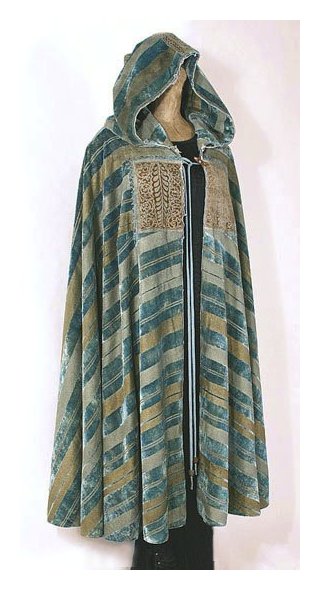
If you have difficulty buying clothes because of a poorly proportioned body you can still collect vintage for occasional wear. Choose looser flowing garments such as capes, cloaks and 1920's dresses. You will also find accessories can make interesting collections and include freer fitting shawls, scarves, belts and hats. Items like reticules and parasols need no fitting!

Fortuny Stencilled Velvet Cape c.1920
This beautiful Fortuny stencilled velvet cape, c.1920 and shown right is a masterpiece from the grandmaster of colour design, illustrating subtle transitions of silver to teal blue to bronze-gold.
Every aspect of fabric design and construction of Fortuny garments was produced at the Fortuny studio.
If you decide to sell such items as capelets, mantelets and cloaks, you may need to rethink your charts for measuring and on occasion photograph such garments flat especially when they are circular to show the buyer the full extent of the cut or print.
(Page Date 18 Feb 2005) Image courtesy of www.vintagetextile.com