Hair salons have long reflected society’s shifting ideals of beauty, gender, class, and self-presentation. From modest trimming parlours tucked behind drapers’ shops to modern-day sanctuaries offering aromatherapy, ring-light selfies, and balayage on demand, the transformation of the hair salon is not merely a tale of scissors and style, but a rich thread woven into the cultural fabric of the last two centuries.
From Grooming Corners to Social Hubs
In the early 20th century, most hairdressers were basic establishments offering utilitarian services including haircuts, hot towel shaves, and the occasional perm for daring women.
Many women had their hair done at home, and those who visited salons often did so discreetly. In fact, in Victorian and Edwardian Britain, frequenting a beauty parlour was sometimes viewed as vain or even frivolous, particularly for respectable middle-class women (Sherrow, Encyclopedia of Hair, 2006).

The role of the hair salon began to change dramatically in the early 1900s, thanks in large part to the rise of Madam C. J. Walker, an African-American entrepreneur widely considered the first female self-made millionaire in the United States. Her business not only catered to Black women’s hair care needs but also offered a dignified space for education, empowerment, and enterprise (Bundles, On Her Own Ground, 2001).
By the 1950s, salons became social hubs, the beauty parlour offered a semi-private space where women could exchange gossip, discuss local affairs, and carve out time for themselves in an otherwise domestic routine. Weekly salon visits had become commonplace among Western women, particularly in Britain and the US.
Hairdressing also became increasingly professionalised. The "shampoo and set" became a ritual. Women booked appointments days in advance, had their hair teased into bouffants or Victory rolls, and returned week after week to maintain their look. Competitions were held to showcase elaborate sets, and stylists such as Raymond Bessone, known as “Mr. Teasy-Weasy” rose to celebrity status in Britain. For the first time, hairdressers themselves became cultural figures, elevating the salon from a local utility to a fashion destination.
The Rise of the Specialist
Until the latter part of the 20th century, hairdressers were generalists by necessity. A single stylist might provide men's trims, wedding updos, children’s cuts, and chemical perms in a single afternoon. Training was vocational and practical, and salons rarely advertised specialties.
That began to change in the 1990s and 2000s, when demand for more individualized hair services surged. The rise of texture-specific salons, such as those trained in the DevaCurl method for curly hair, or “blowout bars” focused solely on styling, redefined client expectations. Today, many salons employ colour technicians, curl specialists, and hair restoration experts, a far cry from the jack-of-all-trades stylists of old.
This shift also reflects broader social trends toward personalization and identity-based beauty, aligned with increasing awareness around natural hair movements, aging, and body diversity (Thompson, Black Women, Beauty, and Hair as a Politics of Representation, 2009).
Setting the Scene: Ambiance and Atmosphere

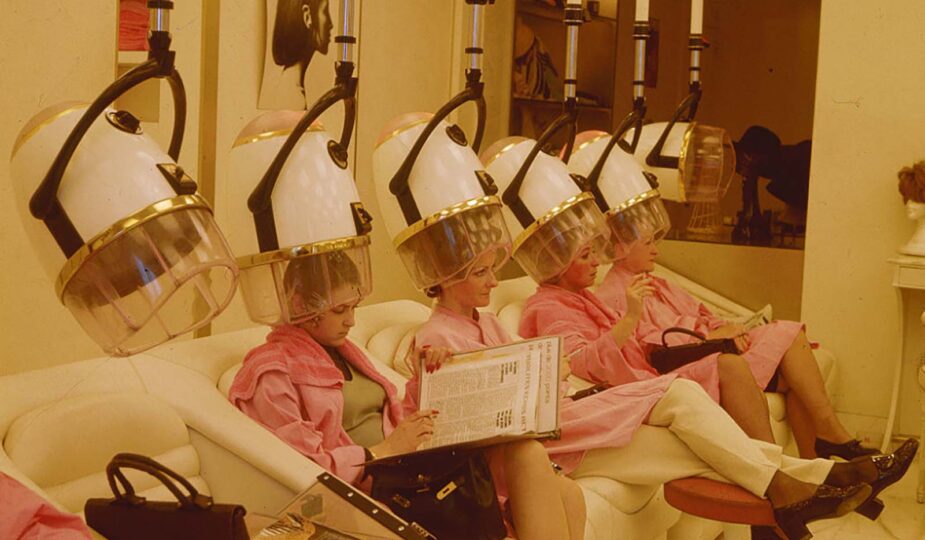
The interior of the mid-century salon was efficient rather than elegant. Linoleum floors, plastic chairs, and industrial lighting were the norm. The aim was turnover and tidiness, not tranquility. For example, photographs of 1960s salons show rows of women seated under hooded dryers in silence, reading Woman's Own magazine while their beehives set.
By contrast, modern salons emphasize ambiance as a core part of the experience. Some are minimalist and meditative; others, flamboyant and Instagram-ready. Clients sip oat lattes or cucumber water, enjoy curated Spotify playlists, and browse curated product shelves that resemble boutique skincare displays.
This evolution parallels broader societal shifts around wellness culture, where self-care is viewed not as indulgence, but as necessity.
Technological Transformation
Hairdressing technology has always marched in lockstep with the broader advancements of its age. In the 1920s and 1930s, thermal waving machines like the Nestlé Permanent Wave Machine used heat and electricity to curl women’s hair, a process so complex it sometimes required over two hours and left the scalp scorched (Brewster, Beauty Imagined: A History of the Global Beauty Industry, 2010).

By the 1950s, more user-friendly versions of hair dryers, curling tongs, and electric razors entered mainstream salons, though many tools were still unwieldy and damaging.
In today’s salons, technology is seamless and smart. Infrared dryers reduce heat damage, ceramic plates protect cuticles, and AI-powered hair simulations allow clients to preview styles before committing. Salons now use booking platforms like Fresha or Vagaro that remember preferences and send reminders automatically.
The industry’s adoption of “beauty tech” has been so swift that even augmented reality mirrors and scalp scanners are no longer reserved for high-end salons in Paris or Tokyo, but found in trendy London boroughs or LA strip malls.
The Clean Beauty Movement
Historically, hair salons used potent chemical mixtures with little regard for long-term health effects. Hair dyes contained high levels of ammonia and parabens, and stylists often inhaled fumes from formaldehyde-laden keratin treatments.
That changed in the 2010s with the rise of clean beauty. Fueled by consumer awareness and advocacy campaigns, today’s clients ask for sulfate-free, vegan, or low-tox options. Brands like Davines, Olaplex, and Aveda lead the charge in offering products that are both high-performance and earth-conscious.
Modern salons proudly display their ethical credentials. Refill bars reduce plastic. Staff are trained in ingredient transparency. The shift is not merely about style but about safety and responsibility.
Inclusion, Identity, and the Breaking of Beauty Norms
For much of the 20th century, beauty services catered to a narrow range of hair types and aesthetics. Afro-textured, curly, or tightly coiled hair was often excluded from mainstream salons or deemed “unmanageable.” In some regions, clients of colour were outright turned away.
In recent decades, salons have become more inclusive, thanks to advocacy, education, and client demand. Training now includes modules on Black hair care, braiding traditions, and culturally sensitive consultations. At the same time, gender-neutral pricing and non-binary styling have become increasingly normalized in progressive salons, reflecting broader shifts in how society understands gender and self-presentation.
This is more than a trend, it is a corrective measure in an industry that for too long dictated beauty from the top down.
Social Media and the Viral Haircut
In the pre-digital age, inspiration came from Vogue, television icons, or the hair model pinned beside the mirror. It could take months for a style to travel from a Milan runway to a Manchester high street.
Today, a single TikTok post can trigger a global style trend in a matter of hours. Hashtags like #butterflycut, #moneypiecehighlights, or #glasshair are not only shaping what clients ask for, but how salons market their services.
Hairdressers have become content creators, wielding ring lights and filming time-lapse transformations. Clients tag their stylists. Review culture flourishes. In effect, social media has turned every styling chair into a potential stage and every stylist into an influencer.
Greening the Gloss
The waste generated by salons is considerable: foil, plastic bottles, gloves, dyes and until recently, little of it was recycled.However, sustainability has now become a central concern.
Some go further still, installing water-saving nozzles, offering compostable towels, or switching entirely to solar power. The green beauty movement, once a fringe concern, is now a marketing badge of honour and a genuine contribution to ecological stewardship.
The Mirror Reflects Us All
The hair salon has never just been a place of grooming. From wartime austerity waves to 1980s power perms, from the layered bobs of the 2000s to the platinum pixie crops of TikTok stars, salons have chronicled our desires, insecurities, and evolving notions of identity.
They are places of revelation and transformation. Whether behind the fringe of a rebellious youth or in the quiet ritual of a pensioner’s weekly set, the salon remains one of the few spaces where self-presentation, community, and culture intersect so intimately.
In the mirror, we see not only ourselves, but the history of who we’ve become.