By Pauline Weston Thomas for Fashion-Era.com
Dress Emancipation for Women Through Fitness

Early in the 20th century it was not considered important for women to win at competitive sports and so clothes were not designed to give the movement that would allow them to excel.
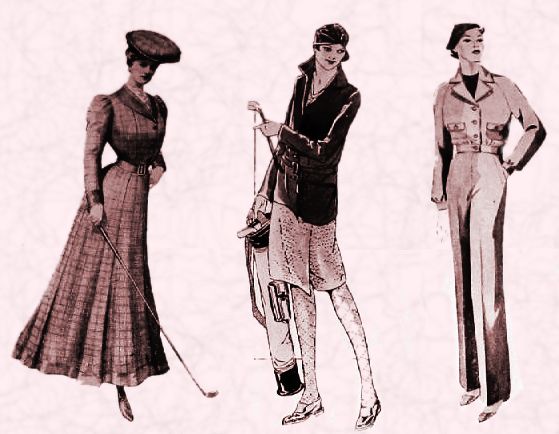
For golf women wore tailored blouses and skirts similar to clothing worn for business and shown in the header.
By 1910 only golf allowed women to have expanding pleats down the sides of their tweed jackets to prevent clothes tearing when they did a golf swing.
Even those pleats could not be decorative.
Tweed was used in many sports and the golf sweater made its way into fashion as the first casual garment.
Above outfits suitable for golf in 1903, 1929 and 1935.
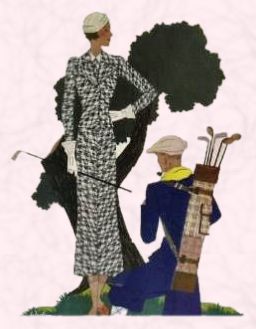
Mass production techniques being applied more swiftly in America, benefited sportswear for women and shorter hems were common on most American sports skirts.
By 1917 Vogue urged women to put their overskirts in a knapsack once on a mountain slope and ski in their jodhpurs.
Acceptance of Beach Pyjamas for Women 1920s

By the 1920s women wearing trousers had become an acceptable fashion.
Workers in munitions factories had worn trousers beneath their overalls and after The Great War they kept trousers for private wear at home.
Later when crepe pyjamas were worn publicly at the seaside, trousers for women were a usual sight, but still quite confined to beach and promenade areas.

Early Tennis Outfits - Alice Marble to Gussie Moran

She abandoned the hat and also caused a stir with her hair bandeau designed to enable her to actually see what was going on.
Such seriousness of purpose was unknown before. By 1930 a bare head was acceptable for tennis playing.
Women had worn long skirts and restrictive clothing to play tennis until 1910. This fashion plate left is dated 1895 and was typical 'sporty' dress for tennis. Note the hats, tight sleeved jackets and heavy skirts.
In 1922 Suzanne Lenglen shocked the world when she dressed for tennis at Wimbledon wearing a short skirt.

Even more shocking than Lenglen was Alice Marble who strode onto court wearing white shorts in 1932. Both outfits were at the time considered outrageous, but over the years other sports women have braved new ground with more appropriate dress.
In 1947 Teddy Tingling influenced by Dior's New look began to put femininity back into tennis wear and produced waffle pique flared dresses. By 1949 Teddy Tingling designed lace trimmed knickers for Gussie Moran to wear at Wimbledon.
Practicality in sports clothes was set in the 1920s. Jean Patou was revolutionary in shortening sports skirts and accustoming people to the idea of suitability of purpose.
You are reading an original 'Fitness fashion', fashion history article by Pauline Weston Thomas at www.fashion-era.com ©.
Skiing Clothes in the 1930s
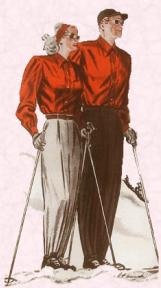
Skiing was the sport of the thirties and clothes were designed for the slopes. The silhouette was long and slender.
Long Norwegian trousers with cuffed hems were worn with short boxy jackets with wide shoulders that accommodated sweaters beneath them.
White, navy or bright trousers were most seen and at the same time a fashion for two tone garments including gloves emerged.
Lastex yarn began to be used in areas where stretch was needed.
Knitwear for skiing had fair isle patterns and motifs illustrating skiers and skaters, trees and snowflakes.

Sunbathing on the slopes became normal and women began to wear swimsuits that had panels which could be rolled down so they gained full sun exposure.
Functional Slacks for Women Gain Acceptance

Trousers were not thought acceptable everyday wear for sports until the mid thirties.
For skating a skirt a skirt was always a popular choice as these illustrations of 1901, 1911 and 1934 show.
By 1936 women began to wear slacks for all form of casual dress particularly in America. But it took three decades for trousers to really gain mass interchangeability with the skirt in the late 1960s and early 1970s.

By the late 30s women were participating in a wide range of sports such as water skiing, golf, running, tennis, fishing, mountaineering, shooting, archery, fencing, skating, as well as riding and cycling which were still thought of as forms of transport.
Slowly sportswear was adapting to meet the real needs of active women.
For tennis, the correct wear was a short dress.
For golf smart suede jackets in strong shades, slacks or sturdy box pleated skirts or culottes were breaking barriers.
For shooting and fishing, pleated jackets, pleated skirts or culottes and Loden wool capes were brightened with Austrian-style trim and embroidery.
You are reading an original 'Fitness fashion', fashion history article by Pauline Weston Thomas at www.fashion-era.com ©.
Utility Effects on Styles
With Utility restrictions on fabric, sportswear took a back seat. The major effect of the war was that slacks became even more suitable wear for sports and that the colours became sombre.
Windcheaters and anoraks still retained prewar styles with close fitting sleeves.
Dungarees and overalls worn in mainstream war work of factory and land girls led to the invention of salopettes.
Mostly they were sleeveless and front zipped all in one and like a siren suit, but sleeved versions existed.
The fabric used for outdoor sportswear was usually gabardine as it tended to repel water on first contact.

Stretchy Knits
Since ancient times men and women have worn garments that stretched simply by the fact that they were knitted. Jersey was invented in the late Victorian era in 1882 and by 1900 was made into breeches for riding. Lastex made from rubber fibres was used for stockings and underwear in the 1930s.
1945 Post-War Functionalism in Sportswear
After 1945 a whole new range of synthetic fibres often best suited in the early days of production to knitted fabrics were made into pullover dresses, underwear and gym tops.
By the mid sixties stretch garments became quite usual and the comfort factor of being able to move with a garment didn't go unnoticed.
left - Windshirts for Skiwear 1947.
The fifties saw revolutionary changes in sports clothes much of it due to the earlier invention and new use of synthetic fibres particularly nylon combined with practical techniques developed in military clothing. For example hoods could be concealed in neck collars.
Pockets in jacket fronts were designed to store snack foods. Gloves had zip pockets for ski passes. Elastic inserts in the sides of ski pants and stirrup straps underfoot made for pull on, pull off clothes all features we expect automatically today.
Athletes adopted nylon running shorts and cotton vests. Zip up windcheaters and anoraks were taken onto the athletics and sports fields to keep off the chill, but often with odd trouser bottoms.
Thoughtful colour coordination only became a norm in the 1960s when thick jersey cotton sweat shirting or nylon jersey track suits in colours like navy, bottle green or grey were the forerunners of vibrantly coloured 80's nylon shell suits.
Tennis whites became available in a huge range of fashion styles and it was up to the individual to make her choice as long as it was white and decent, the outfit could vary from shorts and a top to a pretty flared dress with decorative hemline and frilled knickers.
Teddy Tingling continued to dominate tennis wear in the seventies and eventually it became acceptable to wear coloured clothes to play in.
You are reading an original 'Fitness fashion', fashion history article by Pauline Weston Thomas at www.fashion-era.com ©.
Riding Sports
Cycling, motorcycling and scooter riding were able to easily adapt existing clothes. Denim Jeans, Capri pants and Bri-nylon stretch ski stirrup pants were the narrower trousers women preferred for cycling.

Motorcyclists adopted either the leather aviator's jackets or tweeds both suitable for keeping out the wind.
Vespa scooter owners also liked leather jackets and jeans or black stretch pants, but suede was popular too, and towards the late fifties often followed the beatnik look with a roll polo neck or cowl jumper.
The only sport which remained unaffected by changes was horse riding which stuck to the rigid hard hat, jodhpurs, riding or hacking jacket or sometimes skirt. Read on redingote if you are intersted.
Functional Clothes for Mass Production
Functionalism became strongly associated with sports clothes in the 1950s. The clothes did a job and consumers noticed how useful the features often were in everyday life. Hooded anoraks and enveloping parkas for wet weather were a big feature of the early sixties, yet often go unrecorded.
The greater availability of goods in the fifties meant that consumers now made choices. Rigid sports uniforms were waning. Looks were less important than staying warm, dry or cool and after 1960 huge strides were made to produce clothing suitable for many sporting occasions.
You are reading an original 'Fitness fashion', fashion history article by Pauline Weston Thomas at www.fashion-era.com ©.
60s Workout Clothes
Some features of 60s workout clothes includes bright colors, low waistlines and bold patterns. The miniskirt was all the rage in the 60s, with most hemlines no more than 13 inches from the ground.
The shorter hemline allowed for freedom of movement and lightweight fabrics like knits and synthetics were popular for exercise clothing. Additionally, prints such as plaid or stripes
By the sixties posing in sports clothes began. The track suit was a phenomenon of the 1960s. Matching bottoms were added to the anorak tops athletes wore and the tracksuit was born.
Zip fronted boiler suits were a development from space clothes of 1969 and when made up in fabric like stretch velours were exceptionally sexy 1970's party gear. By the late seventies sportswear and fashion were merging.
70s Workout Clothes
1970s workout clothes were all about being comfortable and fashionable. With a focus on function and comfort, styles such as tracksuits, leotards, and warm-up suits were popular in the 1970s.
Women's workout clothing was often paired with thick-soled sneakers and headbands to complete the look. Men's workout attire included shorts or sweatpants paired with
After 1975 fabrics that had been used primarily for mountaineering, expeditions and hiking also moved into mainstream fashion.
Chlorofibres were used to make vests and underwear to keep expedition teams warm. In the UK, Damart gained a huge following as its specially designed thermal underwear allowed people to wear thinner top clothes without feeling cold.
Diana, Princess Of Wales used to wear Damart underwear so that she could wear lighter fashionable top garments for visits in cooler weather.
Breathable Fabrics - Gore Tex, Activent, Ecolite and Tactel
At about the same time huge advances in breathable fabrics were being made. Gore Tex was the original product used to make breathable, but water-resistant windproof outer garments. Gore-Tex is not a fabric, but a membrane which is laminated to other fabrics such as polyester or nylon to suit a manufacturer's end use for breathable clothing.
Other fibres like Activent a breathable fabric from Gore, Ecolite with its ecological breathable coating and Tactel lightweight nylon which can have an applied waterproof breathable coating, all perform in a similar way. Throughout the 1980s, Gore-Tex was used primarily in skiwear, golfing and expedition wear.
Sympatex
Sympatex is an ultra thin membrane about 1/100th of a millimetre which like Gore Tex needs to be laminated to a backing fabric. The laminated Sympatex seams are sealed to make seams water tight and help create a weather proof system that protects the wearer in adverse wind conditions against hypothermia.
Body perspiration vapour passes out from the fabric, but external vapour cannot penetrate the outer garment fabric working in tandem these feature keep the wearer dry inside
Sympatex was used throughout Europe in the 1990s for outdoor everyday jackets and rainwear as well as for golf wear as protective windproof tops and trousers. These outdoor garments always have a good range of pockets following in the spirit of Barbour jackets and military wear.
80s Athletic Fashion
By 1979 exercise had become a routine part of many people's lives. Yoga was very popular throughout the sixties and seventies. Some played squash, others tennis, some jogged, others joined health clubs and took on the whole package of aerobic working out and pumping iron. For more detailed description of yoga see here.
Dance studios with jazz tap exercise and step classes mushroomed. One famous studio was the Pineapple Studio in London. As the craze grew so did a practical need for sports clothes that were up to the task of being easy care for busy people.
Synthetic fabrics with their easy care, strong and often stretch properties were the ideal choice for most sports. Synthetic materials could also be dyed in strong vibrant colours which were the hallmark of the 80s. Many people liked the comfort of sports clothes and soon clothes designed only for the gym were being worn in the streets.
The 1980's Shell Suit
The 80s saw the arrival of the shell suit - a lightweight front zippered nylon jogging top matched with loose bottom trousers cuff gathered and with an elasticated waist. They were either self lined, lined in fine knitted fabric or lightweight fine silky towelling.
Colours were bright and often combined with a contrast secondary colour and white. Typical combinations were navy and white or sea green, sea green and purple, purple and pink, purple and mauve, purple and yellow, peach and sea green, sea green and pastel aqua, royal blue and pale blue, black and white, red black and white or multi computer generated prints of all those colours with just about every colour in the design.
Initially those who bought shell suits first were those actively involved in sports and seeking suitable wear. Then of course those who took a fitness class once a week began to pose in them wearing them for shopping and picking up children from school.
Until then, the only people walking around in any kind of jogging or shell suit were Physical Education teachers rushing into the supermarket on their way home from a day's work.
So the shell suit moved into mainstream fashion, but as manufacturers began to produce nastier and nastier, ever cheaper looking versions, it became so affordable that it was soon a mass fashion.
Suddenly pensioners began to wear them and within a few short months they lost all cachet and almost died an instant death. A comparative item today is the fleece jacket now worn by grandmothers and great grandmothers.
See the new 90s workout clothes.
The Real Fitness Fashions Of Athletes
Those who were really keen to tone and hone the muscles of their body wanted clothes to show their hard work. A shell suit would never do that as its whole effect was blouson. The answer was aerodynamic Lycra as used in cycling shorts.
Ballroom Dancing
Ballroom dancing remained popular with some groups and became a cult with specific dress and hair styles that marked each era of its popularity.
The New Look inspired puffball net petticoat and tulle dresses of the 1950s gave way to longer above ankle dresses of chiffon and floating semi sheer fabrics with feathered hems all ideal for Quick Steps, Waltzes and Foxtrots.
Latin dances such as the Rumba, Cha Cha and Samba required exotic dramatic Brazilian style performance garments with flesh toned areas of stretch Lycra enhanced sheer fabric, amid strategically placed appliquéd sequin pieces with the whole hugging the body like a decorative glove.
Fleece
PolarFleece fabrics were developed to provide lightweight warm garments for hill walking, hiking and expeditions.
Garment manufacturers like Berghaus produced quality fleece outdoor garments that kept a good appearance long term. Windbloc or Microfleece or Polartec Thermal Stretch are still the types of fleece to look out for as they offer better wind protection than ordinary fleece.
Initially the fleece garments were made from the highest quality fleece, but as time has gone on the grades of fleece produced included lower grades of polyester with the resulting unattractive pilling.
As there are well over 100 types of fleece the consumer needs to pay special attention that they really are getting the quality end. Marks & Spencer sell a wide range of average priced value for money fleeces.
In the 1990s, fleece was used to produce a wide range of simply cut, easy care casual tops worn by all age groups.
Fleeces are likely to go the way of the shell suit as a fashion item if inferior grades continue to be made up into garments as the better quality garments become tarnished by association with lower grade goods. This really would be a shame as the lightweight, practical fleece has its place in fashion and is cosy in specific situations.
1992 Olympic Fashion Influence
It was not only physical excellence that interested viewers of the 1992 Barcelona Olympics, but also cutaway track sportswear. By 1992 sportswear was very serious commercial business. Manufacturers insisted that the skin tight materials used in 1992 sportswear gave competitors a technical edge that would help athletes achieve record breaking results.
Linford Christie's one piece running suit was made of a double layer of fabrics. The outer layer was hydrophobic - water hating and it rejected perspiration sending it into the atmosphere.
The layer beneath next to Christie's skin was hydrophilic - water loving which absorbed moisture. The combination was ideal to keep the runner dry and also cool.
Christie's one piece suit has become standard wear for sprinters. To keep athletes even cooler in hot climates the garment midriff has often been cut out. Women did their own version of this with a cropped top and second skin shorts.
Speedo's S2000 Range of Swimwear
Back in 1992 the Australian brand Speedo produced an innovative range of swimwear called S2000 using a fabric designed by Pentland Industries intended to improve a swimmer's speed.
S2000 was a fabric made from polyester microfibres and Lycra elastomeric fibres and then given a special finish. It was more water resistant than skin because it had a low drag coefficient so all in one up to the neck swimsuits became a fashion for men as it improved performance by 15%.
In 1992 Speedo wearers took 7 gold medals and 4 world records.
By 1996 some 77% of swimmers wearing Speedo swimwear won medals.
Top Sportswear Brands
Today the main sports manufacturing names are dominated by names like Nike, Reebok and Adidas. They spend huge sums of money forging links with athletes and sports personalities. Their aim is to ensure that fans will spend cash on their very own branded sports goods from footwear trainers to head and wrist bands to bag carry hold alls.
To be fair to them they do a great deal of research into producing performance enhancing products. In the 1990s they were all hugely successful as sports and casual wear were favoured as daywear in a dress down society.
Whilst we are a long way from the restrictions of the 1920s once thought so liberating, even today arms go up in horror if it is suggested that a new fabric or sports shoe gives a sports competitor unfair advantage by improving technical performance with wind, grip or water resistance.
The 21st century promises new fabric technology that will enhance sports performance and will ultimately benefit ordinary consumers.
For up-to-date information follow sports magazines with articles on all the latest products and know how to achieve excellence in sports.