
By Pauline Weston Thomas for Fashion-Era.com
Table of Content
- Panier or Panniers
- 18th Century Sack Dress
- 18th Century Laced Stays
- The Gown à La Française 1720
- 18th Century Panier Hoop Frames
- Gown à La' Anglaise 1728
- The Polonaise 1772
- Return to Nature - 1780s
Panier or Panniers
The spelling of this word causes confusion. It is often spelt as panier, but many costume devotees prefer to use the term panier after the French name of panier meaning basket. It is of limited importance which spelling you choose to use - just decide to use one or the other consistently.
18th Century Sack Dress Style

Many of the early 18th-century paintings illustrate ladies' gowns with free-falling, pleated loose dress backs.
This innovation after 1705 was called the French sack dress sometimes called the sac or saque or the contouche.
They are commonly called by the misnomer Watteau gowns, or Watteau pleats simply because the artist Watteau recorded early versions in his paintings.
He did not record later variations.
This sack dress probably developed from the overgown worn in the late 17th century. They were worn with a circular Panier and were fashionable until later than 1730.
18th Century Laced Stays
Under the Sack or Panier dress, well-crafted laced stays were made from as many as 40 pieces of whalebone. They were backstitched by hand and were very decorative.
The stays would support and raise the breasts, narrow to a sharp point at the front as well as define a slim outline. The stays often matched the dress or complimented it in matching silk or brocade gown fabric.
The open bodice was sometimes filled in with an embellished pointed stomacher which covered the stays. The bones in all these stays were placed laterally across both front and back shoulder blades to keep a straight front and an upright back. The décolletage was always visible, but until the 1920s breasts were always treated en masse as one great bosom.
Gown à La Françaíse 1720
After 1720 the sack dress graduated into the gown à la Françaíse.
The loose back was variously made up of folds and unpressed pleats.
As the century progressed the pleats developed into arrangements of single, double, or triple box pleats which were stitched at neck level and then hung from the shoulder line falling down into the skirt folds.
At the front, a V-pointed stomacher had bows in decreasing sizes.

Jewels in decreasing sizes were also used to decorate the same area. All types of women wore this dress, but in different clothes from plain to rich materials. The skirt was supported by paniers that got wider as the fashion progressed.
18th Century Panier Hoop Frames

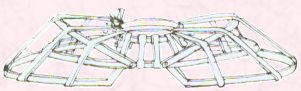
Panier supported skirts first appeared in England in 1709 and in Paris in 1718-1719. Over the years there were many variations. In England, paniers were sometimes called improvers.
Basically, they began as petticoats of heavily stiffened rich fabric, tiered with three or four rows of whalebone with tapes for control.
A separate petticoat covered the paniers and eventually, this became richly decorated, embroidered, and quilted.
Gown à La' Anglaise 1728
By 1728 Panier skirts reached extreme widths.
The gown à la' Anglaise was a practical replacement for the gown à la Françaíse later only kept for court ceremonies.
By 1765 the boned bodice of the gown à la' Anglaise became softer and followed the seam lines of the bodice and the back pleats were sewn down to waist level. This softer look heralded the appearance of the all-in-one, bone-free gown.
The Polonaise 1772
An important style change occurred about 1772 when the overskirt became drawn up by invisibly placed inner tapes producing a ruched festoon bustle.
It was called the polonaise skirt and was supported by special basket hoops as shown in the drawing.
It was said that the fashion arose when maids picked up the sides of their Panier skirts and pushed them into the pocket slit openings to enable them to do their work more easily.
The drawn-up skirt revealed the petticoats and these then became an important fashion.
The chest was forced forward and gave a pouter pigeon effect.

Silhouette Changes and a Return to Nature 1779-1794


Return To Nature 1780s
A gradual return to nature and simplicity introduced a more natural silhouette in the late 1780s. Of course, once the French Revolution of 1789 occurred there was no way the aristocracy could flaunt their social class by wearing heavy silks and satins.
The polonaise disappeared and the open robe became high-waisted and was known as a frock. The frock was simple in cut and cloth, usually in white fabric not requiring corsetry or lavish embellishment. It made way for the simpler styles of the next century.
Together, these three fashion elements contributed to the distinctive and elegant style of women's clothing during the 18th century, which is often associated with the court of Versailles and the reign of Louis XV.


