By Pauline Weston Thomas for Fashion-Era.com
Stays and Corsets
In both England and America the word corset replaced the word stays. The soft muslin dresses of 1800 clung to the body highlighting the natural body outline. This made it difficult to wear stays, but those with imperfect figures had no choice.
The stays were boned less than in the late 18th Century and were lighter in make-up. The newly lengthened stays gave a smoother slinkier shape to the hips and thighs and the bust gained a more natural outline.
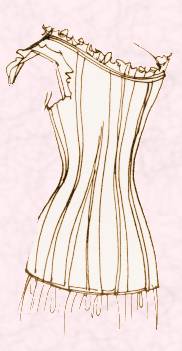
When it became fashionable to wear a white slippery silk satin slip over the stays, the dress line became quite smooth as the muslin flowed over the silk underskirt. Later, extra fullness at the skirt back, was supported by a small bustle pad.
The Empire fashions at the turn of the century were often little more than sheer nightgowns. The practical solution to the discomfort of lighter clothing was to adopt the warm male undergarment called pantaloons. Made of light stockinet in a flesh colour they went all the way to the ankles or to just below the knee.
The flesh-tone pantaloons acted in the same way flesh-toned bras and briefs do today under white or pastel trousers and tops. It is for this reason that Empire women seen in paintings of the era, often appear to be wearing no underwear.
You are reading an original ' Stays to Corsets in Underwear', fashion history article by Pauline Weston Thomas at www.fashion-era.com ©.
In the 1820s the skirts widened with frills and were often horsehair padded at hemline to make them stand away from the legs. After 1820 corsets were worn again by all women.
By 1825 the high waist had dropped to its normal position, but skirts became wider and shorter to balance the increasing sleeves. Corsetry was a must again to show off the narrow waist. In the mid 1830s basque shaped pieces were added to the hips.
Corsets after 1840
After 1840 the corset was of a new style made from seven to thirteen individual pieces. The gusseted reinforced stitched corsets of strong white twill cotton, used vertical rows of whalebone shaped to the natural body shape. They were still laced at the back.
Evening dresses had such low décolletage showing exposed shoulders, that the corset had to lose its shoulder straps and become free-standing. Because the dress bodices were lengthening the actual dress bodices were boned in sections and this gave not only extra contour but also helped stop creasing across the body fabric.
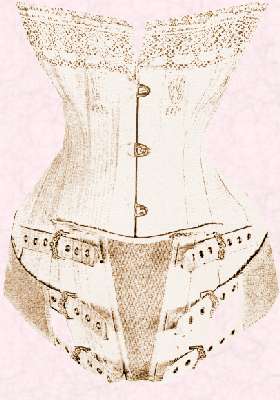
Right - Madam Cave's patent Corset of 1884 without shoulder straps, but with abdominal over belt to keep the figure to proper proportion. Recommended by The Lancet as it was thought to be designed with healthy intentions.
The Mature Edwardian Figure
Fashions favoured the mature woman in the Edwardian era. It exhibited the curves of an elaborately corseted figure. The Edwardian era was the last period in fashion history when the mature female figure was every man's ideal.
Buxom ladies tortured their flesh to achieve an hour-glass figure. Young or old, all laced themselves so tightly that they distorted their figures into the exaggerated 'S' shape associated with the era.
The Health Corset

The corsets favoured in the 1890s and 1900s were the 'health' corsets initially designed to aid women to breathe freely. Mme. Gaches-Sarrauteof Paris, a corsetiere who studied medicine, designed a corset intended to aid health instead of endangering it.
She introduced the straight-fronted busk which was aimed at leaving the thorax free, but at the same time designed to support and raise the abdomen instead of compressing it and forcing it downwards.
She rightly, aimed at removing pressure from the vital female organs and dispensed with the constricting curve at the waist which was customary in all previous corsets.
Medical books of the era gave images like these which suggested changes to the internal organs and skeletal frame due to wearing over-tightened corsetry. The Edwardians and Victorians were quite capable of a little artistic licence too.
The S-Bend Corset Fashion to Tight Lace
Ladies would, at last, have been free to move and breathe easily, but the craze for a small waist persisted and its easy achievement was reinforced by the availability of a maid.
Pulled very tightly the "health" corset produced a hand-span waist, but at the same time, the straight-fronted busk forced the bust prominently forward, whilst throwing back the hips, creating the 'S' shape characteristic until 1907.
The Monobosom Effect

The general impression given was of an enormous one-piece bosom, referred to as a monobosom.
Because the bust was largely unsupported, ladies began to wear various styles of bust bodices and added extra padding, even handkerchiefs, to increase the frontage which hung low over the waist.
The bust bodice was in use by 1905 in England and was the earliest 20th-century bra, but never got patented.
The Corset after 1907


After 1907 the wasp waist became less acute and corsets became straighter. The corset of 1907 achieved a long slim silhouette. The corset started just above the waist and fitted well down the thighs. They often had elastic gusset inserts which were supposed to increase the comfort level.
As ever fashion won out and to match the new longer slimmer dress styles of 1912, corsets increased in length and almost reached the knees, making sitting down quite difficult.

Veblen's Corset Theories
Veblen's comments on the corset are particularly relevant to the Edwardian woman:
'.... the corset is, in economic theory substantially a mutilation, undergone for the purpose of lowering the subject's vitality and rendering her permanently and obviously unfit for work.... the corset, and the general disregard of the wearer's comfort which is an obvious feature of all civilized women's apparel, are so many items of evidence to the effect that in the modern civilized scheme of life the woman is still in theory, the economic dependent of the man, - that,.... she is still the man's Chattel..... '
and further on he writes:-
'The women of poorer classes, especially of the rural population, do not habitually use it except as a holiday luxury. Among the classes, the women have to work hard, and it avails them little in the way of a pretence of leisure to so crucify the flesh in everyday life.
The holiday use of the contrivance is due to imitation of a higher-class canon of decency.... .it may be said that the corset persists in great measure through the period of snobbery..... it continues in use wherever and so long as it serves its purpose as evidence of honorific leisure by arguing physical disability in the wearer.'
Veblen's theories aptly apply to the Edwardian lady, who was quite helpless in many ways once laced into her corset. Engagement in sports was certainly difficult, although not impossible; engagement in housework was equally difficult and undesirable.
Wearing the corset merited the assistance of another; a personal maid who could pull and tug at the lacing, reducing the normal circumference of the waist from 25 or 27 inches to 20 inches. The corset was functional in that it prevented any function in everyday chores.
On a young body with about two years of training a hand span 16-inch waist which some dressmakers considered ideal, could be achieved. When people wonder today how past women had such small waists they forget that those women worked at wearing a corset daily in the same way as a woman today visits a Gym to tone her thighs.
The corset for the Edwardian woman was then, a status symbol showing she belonged to the leisure class.
The 1911 Elastic Belt and Bust Bodice
In 1911 elastic belts were first worn and were frequently adopted by younger women when they were active during the First World War.
About 1910 the bust bodice became essential and could not be left off as less support was worn. By 1914 a simple darted band a few inches wide with fine straps and worn under the bust and covering the nipples was an alternative to other underwear. It was a forerunner of the brassiere.
The exact date of the forerunners of the official bra designed by Mary Phelps Jacobs in 1913 is thought to be about 1908.
Obviously, there was a need for separating bust support at that time, but several countries maintain that they had versions of the bra before her invention. However, it was Mary Phelps Jacobs who got the record book's attention because she was astute and clever enough to patent the item in 1914, under the name of Caresse Crosby. Read more: Bras and Girdles Before 1950.
Once the First World War was over, women's attitudes and fashions shifted. There could be no return to the heavily boned corset as it had been in former times. The world was ready for bras and girdles.
See 6 Edwardian Fashion Plates Sept 2004
Footnote :-This page was partially based on content I updated from a dissertation I first wrote in 1979. The dissertation a Comparative Study Between the Rôles of the Edwardian Hostess and the Edwardian Seamstress looked at the symbolism behind Edwardian dress and the rôles of women in Edwardian society. In particular it examined the rôle and high lifestyle of Edwardian society hostesses compared with the degrading working conditions and impoverished lifestyle of the seamstresses that made clothes for hostesses.