By Pauline Weston Thomas for Fashion-Era.com

- 1913 Photos of Edwardian Mourning Clothes
- The Fashion To Mourn Publicly
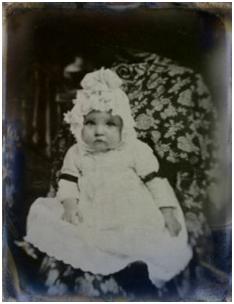
- Tintype - A Baby With Mourning Bands
- Mourning Clothes and Crape
- Stages of Mourning
- The Demise of Excessive Mourning to a Realistic Respect
- Mourning After 1950
- Old Mourning Dress Photo 1919
1913 Photos of Edwardian Mourning Clothes
I was recently sent this wonderful photo from 1913 with the request to research information about their costume and occupation from the photograph.
The sender thought the women were wearing some kind of uniform related to their religion.
All I was told about this old photo was the known date of 1913.
It's always good to have a known date to the picture, but the sender needed to clarify ideas about the people in the old photo.

My first reaction was women in mourning dresses and that this was a family photo taken after the death of perhaps the mother in the family. Since they are fully grown women it does not seem unreasonable that their mother had become ill and died. At this point I was not aware of their identical family surnames, neither did I know the birth dates of all three characters.
Both women wear identical dresses of the era and this may be because mourning styles were limited in order to keep them fashionable. On close inspection they also both appear to be wearing a simple and limited tasteful amount of mourning jewellery.
Itís interesting in that the young women have personalized the dresses Ė one has removed, or turned-in, the contrast shiny fabric waistband belt.
The dresses also have some decorative elements such as small pattern guipure lace neckline yokes and deep cuffs of lace, plus decorative button trim. The mourning dresses have moved beyond the untrimmed plainest of mourning gowns, indicating that this photo was taken more than six months after first stage mourning.
I also thought one other interpretation was that the two women were shop workers or reception staff or schoolmistresses and had to wear the same gown for uniformity. For example, they could have been the main housekeepers in a large manor house or hotel.
Little Details


Mourning jewellery was an important part of mourning dress. On the left we see a dark possibly jet brooch and on the right a black necklace made of black beads with a black cross.
It is unlikely that young women of that age would wear such a totally black 'day' dress if they were not in mourning.
Their mourning dresses are unlikely to be one piece dresses, but as was the custom at the time, consisted of two pieces of garments, but still described as a dress. After 1908 the fullness in dresses became reduced as narrower fashions emerged.
As a result over the next five years more dresses began to be constructed as one piece gowns. When skirts also shortened c1915/16, frocks were more usually just one piece especially as waists were elevated. When made as two pieces the bodice top was often called a waist and was worn with a fabric matched skirt.
The skirt style is quite fashionable with all those side buttons, but not as narrow as many dress images of 1913. The blouson bodice style was seen many years before, but the narrow straight sleeves are of the later Edwardian era. By 1913 many women were wearing under-the-bust empire line gowns. These dresses are only very slightly above the waist if at all.
By 1913 a V-neckline was the most fashionable neckline and the V-neckline was denounced from the pulpit for its vulgarity. This neckline suggests a respectful, demure and serious approach to the nature of the event with such an all occasion dress rather than desire to be fashion conscious with limited use occasion dress.
The manís flower is probably pinked stiffened silk fabric Ė it has a black button in the middle which would make it a mourning accessory.
For him it was a significant outward sign of mourning garb. The photograph may even have been taken as a family effort to show other family members that this nuclear family was strong in its unity to the rest of their family wherever they were in the world. If the family was large they may also have been the most important and significant family members. These women may have acted as mothers to younger children.
Note that the man has a large volume of black fabric - a cravat or tie at his neck. From these facts I thought it fair to assume the sitters were all in mourning dress.
The manís fingers and fingernails are dirty. The marks on his fingers suggest permanent scarring such as the blue black marks a coal miner picks up when he cuts himself and can never rub them clean of coal dust when he washes and thus gains a permanent 'labour' tattoo.
From this I concluded he must have been a worker in manual trades rather than say a full time religious preacher or doctor despite his clean respectable attire.
Look closely at the enlargement of the photo far right and you will see he also wears a gold wedding band on his little finger which might be the only finger his recent wifeís ring would fit.
More Details


A few days later I was told that this old photo is of Newton Weddell (1849-1921), Hannah Weddell (1878-1942) the lady on the left, with Mary Weddell (1889-1961) the lady on the right.
Other information I received later about these sitters was that Newton Weddell was from Newcastle upon Tyne, UK. He was a slater and tiler by profession (which helps explain those permanent black marks on his fingers). Despite his working class background he was a Freeman of the City due to his grandfather being a member of the Tanners' Guild. His wife Jane, with whom he had ten children, died in 1912.
The photograph was sent to his son William in Australia - the message on it reads "A Merry Xmas and a Happy New Year from your loving father and sisters."
Page added 12 November 2006 Ref P617
The Fashion To Mourn Publicly
The complexities of wearing mourning dress took hold as the Victorian era progressed following the death of Prince Albert in 1861.
Queen Victoria wore her widow's weeds for the remainder of her long life until 1901, when the Edwardian era began.
Many who saw themselves as fashionable, including those in the lower classes, followed their Queen's example.
The middle classes in particular, wishing to follow and accept the higher canons of decency of the upper classes, thus they emulated every example she set. They liked to use black edged stationery, envelopes, notepaper and visiting cards.
Prayer books and bibles had to be bound in Black morocco leather and handkerchiefs edged in black. The list was endless, but all touches were intended to convey to the onlooker through a series of signs and symbols visual messages that the deepest feelings of sadness were felt at the loss.
They tied little black or purple ribbons around dressing table bottles and added similar purple or black ribbons even to the clothing of infants.
A Baby in Mourning - TinType Image
This is picture of a baby in mourning brings home the importance of mourning to the Victorians and Edwardians. This C19th tintype picture was recently sent by a site visitor. It shows a baby in mourning wearing black armband ribbons, a sign of the baby having suffered a close loss. If you have images that might be relevant to this website perhaps you could send me a good scan and with any known information.
Women in Mourning
Women were the leaders of a household's mourning drill. It was the woman who as the social representatives of their husbands showed the world how sorrowing the family was by wearing clothes and following little rules that reflected this.
While royal attitudes to mourning permeated down throughout society, often these attitudes were totally impractical for the majority of the population. This was because royalty not only had the finance to afford conspicuous consumption of the excessive rules of mourning etiquette, but also little need to labour unduly hard.
Advice on what mourning clothes to wear, what mourning etiquette to follow abounded in magazines for women. In 1865 Henry Mayhew the social historian remarked that '… Women, … had to put aside all their ordinary clothes and wear nothing but black, in the appropriate materials and with particular accessories, for the first stages of mourning.'
Mourning Clothes and Crape
Mourning was an expensive activity and also wasteful, because it also had to be fashionable. Identical in fashion styling to the modes of the day, it used different colours and materials.
When more than one death occurred in a family with little space between them, mourning clothes would inevitably be worn for several years non stop. As normal clothes were put away they would often be out of fashion by the time mourning was over so they were sometimes remodelled and often discarded.
Crape (always spelt with an ‘a' to indicate mourning crape) was the most used fabric for mourning clothes. It was used in such vast quantities in the 1890s that Courtaulds built a textile empire on the sales of the crape cloth alone.
Crape was dull looking silk gauze like a crimped and stiff textured material and mostly dyed the deepest of blacks, although white crape was used for the widow's cap.
Black was the chief mourning colour in the immediate months after a death for deepest mourning. Dull surfaced black fabrics such as crape, plain bombazine, paramatta, merino wool and cashmere were also favoured and used depending on income.
Stages of Mourning
A widow would mourn for two and a half years, with the first year and a day in full mourning. During that time pieces of the crape covered just about all of a garment at deepest mourning, but the crape was partially removed to reach the period of secondary mourning which lasted nine months.
After that the crape was defunct and a widow could wear fancier lusher fabrics or fabric trims made from black velvets and silk and have them adorned with jet trimming, lace, fringe and ribbons.
In the final six months a period called half mourning began. Ordinary clothes could be worn in acceptable subdued shades of grey, white or purple, violet, pansy, heliotrope, soft mauves and of course black.
Every change was subtle and gradual, beginning firstly with trims of these colours being added to the black dresses. These were the transitional mourning dresses from secondary mourning to the final stage of lesser ordinary half mourning where colours like purple and cream rosettes, bows, belts and streamers along with jet stones or buttons were introduced.
Similar rules applied for the wearing of hats or bonnets. As the mourning progressed, so the hats and bonnets became more trimmed and fancy, whilst veils became shorter until they were eventually removed altogether.
The Demise of Excessive Mourning to a Realistic Respect
The fashion for heavy mourning was drastically reduced during the Edwardian era and even more so after the Great War. So many individuals died that just about everyone was in mourning for someone. By 1918 a whole new attitude had developed and this was hastened even further by the Second World War.
Mourning After 1950
By the 1950s in the UK women mourned for about 6 to 12 months wearing black and other dark colours like navy or bottle green or subdued tones. In the 1960s individuals started to wear colours like navy, purple or grey to funerals.
By the 1980s it became usual for some, although not all people to only wear black at the actual funeral. Evidence of old habits like drawing the curtains when a person died was also on the wane as more and more people died in hospitals and the bodies were taken immediately to a resting chapel.
As far as possible active participation in grief in the late 20th century was removed from the majority of people and thought too unpleasant to deal with.
Undertakers took over as many aspects of possible of the actual funeral. This may be why so many do not initially understand the natural grieving time of about 2 or more years that occurs when a truly loved person dies. But time is a great healer and the Victorians understood this in a way the modern world has lost grasp of.
By 2000 any dark colour was thought acceptable at a funeral, with attendance being considered far more important than the clothing. Evidence of this was shown when H. R. H Prince Charles chose to wear a dark navy blue suit to the funeral of the Princess of Wales in 1997, because it was the suit Diana most liked him to wear.
Analysing Old Photos of Mourning Dress
Old Mourning Dress Photo 1919
Genealogy is fascinating. You may have old photos that tell a story as you search for your roots.
It is never too late to ask older family relatives who someone in an old photograph is, or what they can recall of the person or the events.
This old mourning photo left was sent to me by a site visitor Kathleen.
The photo was taken in 1919 in New York City and is a photo of Kathleen's grandmother. It shows a woman in the throes of grief after the death of one of her children.
Note the mourning jewellery of jet black beads and the careworn unsmiling indifference to the camera.

This old photo is of Johannah McGrath, married to William Keating. Thousands of miles from the USA a relative in Ireland sent Johannah money to have a mourning picture taken and sent on to Ireland. Johannah was 50 when her daughter, aged 12, died after a few years of kidney and heart disease.
Kathleen had gleaned information from her own mother about this image and the circumstances of her grandmother. She told me Johannah had worked so hard to keep Eleanor (her daughter) alive. Kathleen was also aware of death dates of two other children in 1901 and 1902 and even believes another child died prior to 1901.
This old photo above highlights the personal torment showing sadness on the sitter's face so much so, that is almost palpable. It is thought by many that there is no worse loss than being in the position of witnessing the burial of your own child, but to have buried several must have been totally soul destroying. You can feel her pain and loss.
I really hope she came to smile again one day and lived to see here own grandchildren born.
The second old photo Kathleen sent me is of Johannah with her husband and her sister-in-law. It was a tin type photo taken when she was about 20 years younger.
In this photo Johannah is totally clothed in black mourning dress. Only her hat has a concession to some subdued paler colours, probably greys, purple or mauve. Note that her parasol umbrella is also in deep black which lends credence to the idea of her wearing mourning dress. It was important that accessories were also in black and were dedicated mourning items.

The full black balloon sleeves indicate the fashion style of 1892-1895.
But the sleeves are not at the maximum leg o'mutton puff sizes of 1895, so one might surmise that the sleeve styles could be earlier or later than 1895 - later with the volume on the wane at 1897.
Since Johannah was a dressmaker it seems likely she would have sewn a fairly fashionable dress for herself.
However as death/mourning dress was big business she may well have bought the gown ready made.
Johannah was married in 1892, but a sister of hers died in 1892. The sister-in-law who sits beside her entered a convent in 1893. With some easy detective work we can surmise that the sleeve style, the convent entry both coupled with the death of Johannah's sister in 1892 means the date of this old mourning photo is 1892/3.

