By Pauline Weston Thomas for Fashion-Era.com
- Gold in Ancient Egypt 3000 BC
- Gold and Gems in Greece 1400 BC
- Italian Gold and Roman Coinage
- C13th Medieval Sumptuary Laws
- Gems and Pearls Real and Fake
- The Importance of C17th Earrings and Dress Ornaments
- C17th Fake Pearls and Strass Paste Gems
- Empire Jewelry
- Parures and Cameos
- Victorian Jewelry
- Mourning Jewelry
- Arts and Crafts Jewelry
- Art Nouveau
- Queen Alexandra's Pearls
- Mikimoto Pearls
- Pearls
- Cocktail Jewelry
- Hollywood Influence
- Television Influence - Dynasty, Dallas and Diamante
- Jewelry for the C21st
The History of Fine and Fake Jewelry
Gold in Egypt 3000 BC
In the ancient world gold was the preferred metal for making jewelry. It was rare, did not tarnish and best of all it was malleable, so it could be worked fairly easily.
Magnificent bracelets, pendants, necklaces, rings, armlets, earrings, diadems, head ornaments, pectoral ornaments, and collars of gold were all produced in ancient Egypt, the land of the Pharaohs.
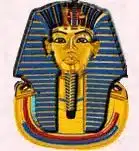
Excavations by Howard Carter in 1922 led to the great discovery of Tutankhamun's tomb and many gold funerary artefacts, all showing the artwork of ancient Egypt.
Gold and Gems in Greece 1400 BC

In ancient Greece, beads shaped as natural forms like shells, flowers and beetles were manufactured on a large scale.
Beautiful and delicate necklaces and earrings were found in burial sites in Northern Greece. By 300 BC the Greeks were making multi-colored jewelry and used emeralds, garnets, amethysts and pearls.
They also used coloured stones, glass and enamel. Carved cameos of Indian Sardonyx (a striped brown pink and cream agate stone) along with filigree gold work were widely made. Beads were made by joining two flat pieces of gold and filling them with sand.
Italian Gold and Roman Coinage
Eight centuries BC the Italian Etruscans in the Tuscany region produced granulated textured gold work. They made large fibulae or clasps, necklaces, bracelets and earrings. They also made pendants that were hollow and could be filled with perfume. The Italians are still renowned for high-quality stylish trend making gold work today.
In coinage, the Romans used 18 and 24-carat gold. Being fairly easily available the coinage was the craftsman's raw material for decorative jewel work. 2000 years ago the Romans were using sapphires from Sri Lanka, cloudy emeralds, garnets, amber and Indian diamond crystals, in effect they controlled the wholesale jewlery of the ancient world. When England was under Roman rule, fossilized wood called jet from the North of England was carved into interesting pieces.
C13th Medieval Sumptuary Laws
Sumptuary Laws in C13th Medieval Europe came into force and capped luxury in dress and jewelry. Townspeople in France were not allowed to wear girdles or coronals made of pearls, gemstones, gold or silver. Similar laws existed in England. The fact that these laws forbade yeomen and artisans from wearing gold and silver indicates how the status of jewelry and sumptuous dress had become widespread beyond just the nobility.
Gems and Pearls: Real and Fake
Jewels have always been used as love tokens and whilst many pieces were fine gems and precious metals, good fake jewelry intended to deceive existed. True gemstones and pearls originated from the East and were bought chiefly by the Italians. The Italian merchants then sold the goods in Europe. Good glass imitations were often used and sometimes with intent as in royal funerary robes and children's jewelry.
Flawless, round, natural, large white pearls were prized more than precious gemstones. The finest of pearls were provided by South India and the Persian Gulf, see good examples of pearl jewelry.
The Italians, particularly the Venetians and people from Murano, could make imitation glass gems and pearls that were very good likenesses of the real jewels. Recipes for false pearls existed in 1300 when white powdered glass mixed with albumen (egg white) and snail slime, produced beads that were used as imitation pearls.
The Importance of C17th Earrings and Dress Ornaments
In the C17th a woman always donned her earrings whether dressed or undressed. By day fake pearl earrings and paste earrings to coordinate with clothing were acceptable. Fine diamond jewelry was kept for the evening and embroidered stomachers which formed part of the dress frontage, could be decorated by jewels.
Suites of left and right coordinating jeweled pieces called dress ornaments decreased in size as they were placed down the stomacher. Sometimes the sleeves or skirts were decorated with smaller matching brooches.

Dress ornaments in the form of diamond bows and shuttles. As many as 42 shuttles could be used to decorate a dress.
17th Century Fake Pearls and Strass Paste Gems
In the 1630s large quantities of pearls were used as clothing accessories. To be truly fashionable pearls needed to be worn in abundance. In the C17th, Jaquin of Paris patented a method of making fake pearls. He coated blown glass hollow balls with varnish mixed with iridescent ground fish scales. The hollow balls were then filled with wax to strengthen them. This method made Paris the main producer of fake pearls for over 200 years.
Paste is a compound of glass containing white lead oxide and potash. Paste jewelry was usual in the 1670s and was worn at court. The best and most long-lasting paste jewelry was produced after 1734 by Georges Strass. Most fake jewelry was Paris-led. Just about any kind of fake gem could be made, including fake opals. Many pieces of fake jewelry have survived in their original setting, but fine estate pieces of real gems were often broken up for resetting into more fashionable styles of the era.
After 1760 the production of fake jewelry spread to London and to Birmingham. Steel which was produced easily during the industrial revolution was used for settings for marcasite and jasper ware cameos. Glass and Wedgwood porcelain paste cameos were made in English factories and were very popular too.
Ornate shoe buckles of paste, steel and tin were part of fashionable dress. A similar fad at this time was elaborate paste jeweled buttons, fashionable in British society. As well as fake jewelry gaining popularity, semi-precious jewels such as uncut garnets became usual as part of a less formal day dress.
You are reading an original article about the History of Jewelry by Pauline Weston Thomas only for publication on www.fashion-era.com ©.
Empire Jewelry History
When Napoleon eventually emerged as Emperor of France in 1804 he revived jewelry and fashion as a new court of pomp and ostentatious display evolved.
'Joailliers' worked fine jewelry and 'bijoutiers' used less precious materials.
The members of the new French imperial family had the former French royal family gems re-set in the latest neo-classical style. These new trends in jewelry were copied in Europe and particularly England. Greek and Roman architecture was the main influence for designs as famous discoveries of ancient treasures had not yet happened.
Parures
Parures were a matching suite of coordinating precious gems which could include a necklace, a comb, a tiara, a diadem, a bandeau, a pair of bracelets, pins, rings, drop earrings or cluster stud earrings, and possibly a belt clasp.
Both Josephine and later Napoleon's second wife had magnificent sets of Parures. On the right is a parure consisting of a bracelet, necklace, ring, and earrings.

Cameos
After Napoleon's cameo-decorated coronation crown was seen, cameos were the rage. Sometimes cameos were carved from hardstone, but more often from substitutes like conch shells and set pieces of Wedgwood porcelain.
Victorian Jewelry
When Queen Victoria came to the throne in 1837 jewelry was romantic and nationalistic. It gave attention to the pressure of European folk art, which later influenced the Arts and Crafts Movement. Until the mid-century most Western jewelry came from Europe, but soon jewelry began to be made in America and Australia.
Although jewelry had been made by multiple methods of production for centuries, mid-Victorian mass production in Birmingham (England), Germany and Providence, Rhode Island meant that standards were lowered.
Victorian women rebelled when they saw some of the machine-made jewelry on offer, although much of what has survived is of good quality. Many wore no jewelry at all, or bought from the artist-craftsman jewelers who emerged at much the same time.
Some jewelers like Tiffany began to make fine jewelry of such high standards that they soon opened shops in the main cities of Europe.
Mourning Jewelry History
There was a huge fashion for mourning jewelry which highlights how sentimental the Victorian age was. The initial months of mourning were unadorned by jewelry of any kind.
As the mourning rituals increased, mourning jewelry developed as a fashion item. Jet jewelry was worn a great deal by Queen Victoria after Prince Albert's death.
Jet from Whitby, North of England was set into mourning pieces. All types of material that were black were used and almost all included a lock of the dead loved one's hair.

Hair was also plaited, braided, or twisted very tightly until it became hard and thread-like. To many of us living in the twenty-first century the use of hair is an unattractive side of some antique jewelry.
Arts and Crafts Jewelry
The new design philosophy of Arts and Crafts that sprang up after 1870 was a reaction to mass-produced goods and inferior machine-made products. It was a reaction to the shoddy interior and ornamental products of the industrial revolution. Leaders of the movement in England included William Morris and John Ruskin and they promoted simple Arts and Crafts of designs based on floral, primitive or Celtic forms worked as wallpapers, furniture and jewelry.
The polished stones used in Arts and Crafts jewelry gave a medieval, simpler, gentler, tooled hand-made look and feel to items. People inspired by the movement to produce work of a more individual nature included Liberty of London and Renee Mackintosh of Glasgow. By 1900, Arts and Crafts as a movement declined, so Art Nouveau, a more ostentatious version started in France took root.
Art Nouveau
Art Nouveau jewelry follows curving sinuous organic lines of romantic and imaginary dreaminess, with long-limbed ethereal beauties sometimes turning into winged bird and flower forms. The movement began in Paris and its influence went throughout the Western world.
The Frenchman René Lalique was the master goldsmith of the era of Art Nouveau producing exquisite one-off pieces. As an art movement today, the style is still admired and still copied.
Magnificent floral and botanical forms often worked in enamel were inexpensive and became so popular once mass-produced, that the Art Nouveau style declined.
You are reading an original article about the History of Jewelry by Pauline Weston Thomas only for publication on www.fashion-era.com ©.
Queen Alexandra's Pearls

Most fine jewelry in the 1900s was white and made from either diamonds or pearls. Queen Alexandra initially wore dog collar chokers, called a 'collier de chien' to cover a small scar on her neck.
For state occasions and formal events, she plastered herself in arrangements of pearl necklaces. The rarity value of real pearls then was such that an American skyscraper exchanged hands for the price of a pearl necklace.
This is not as ridiculous as it seems, as fine south sea pearls still command a high price.
Mikimoto Pearls
Pearls were very fashionable but still very, very costly. After the 1890s Kokichi Mikimoto of Japan produced highly acceptable cultured pearls by placing a small bead into an oyster shell. The bead coated itself with nacre (mother of pearl) and so good-looking pearl jewels became more affordable.
When I see Mikimoto pearls today I always think their luster far surpasses any other pearl made this way.
Various combinations of pearl necklaces come in and out of fashion with regularity so pearls too are a must. Both fake and real freshwater or cultured pearls are very affordable today. Many are now bought from China since trade opened up in the nineties.
The price of pearls has dropped by about a fifth in the past 10 years and the Chinese are making waves in the pearl world with their cheaper prices. The Japanese have suffered disease in their pearl beds as well as facing competition and are finding it hard to compete with China's prices.
Pearl necklaces and pearl earrings can lift a complexion and bring light and radiance to the face taking years off a woman whatever her age. If you can afford it, invest in a pair of Mabe pearl earrings. They have a wonderful white glow with a size about one centimeter across and look expensive. Expect to pay about £300 for a pair trimmed with 9ct gold.
Look after your pearls by rubbing gently with a pure silk scarf, store them in their original box and always put them on after applying perfume and hair products. A matching real pearl necklace freshwater or cultured will enhance them and you.
Pearls are currently back in fashion again and with the modern twist of being interspaced on gold wire or floating on a special synthetic cord, they are essential to the millennium look. Look out for variations too on drop pearl earrings in the next year or so.
Cocktail Jewelry History
In the 1920s Lalique designed good mass-produced quality glass jewelry. Fake, or costume jewelry was sometimes then called cocktail jewelry. It was greatly influenced by Coco Chanel (1883-1971) and Elsa Schiaparelli (1890-1973). They both encouraged clients to use costume jewelry and mix it with genuine gem pieces they already owned. Both designers offered imagination and fun and both often sported fabulous fakes.
In the late 1930s Napier of the USA was at the forefront of manufacturing fake cocktail jewels, which offered glamour and escapism. Napier still produces excellent contemporary costume pieces.
Hollywood Influence
By the 1940s and 1950s American culture was very dominant in Europe. The influence of movie films and the prominence of film stars set the fashion in manners, make-up, hair and clothes. People wanted look-alike copies of outfits and jewelry worn by screen idols. It was widely believed that Hollywood glamour would rub off on you if you had the clothes and developed the look.
The Second World War in Europe halted the production of fine jewelry when metals were rationed. New estate type, fine precious metal and gem jewelry were simply not available. Quality costume jewelry which was flourishing in America became much more acceptable and was a real alternative to fine jewelry.
Because of technical advances in production methods, a huge range of styles was available from America, and since it was so popular the market became dynamic and inventive, and affordable.
1980s Television Influence - Dynasty, Dallas, and Diamante
In the 1980s there was a huge revival of costume jewelry after the glitzy scenes from the television soap operas Dynasty and Dallas were watched by 250 million viewers in the consumer boon of the 1980s. Diamante by day became the norm in reality and earrings reached such huge proportions that the 1990s saw a reaction that quickly dated lavish dress jewelry as the fashion for tiny real diamond studs or fine stud pearls became the only earring to wear.
As soon as the fashion was declared dead by everyone, including grandmothers, it was revived again in 2000AD by the fashion cognoscenti. Now fabulous fakes, especially brooches have gained ground once more.
You are reading an original article about the History of Jewellery by Pauline Weston Thomas only for publication on www.fashion-era.com ©.
Jewelry for the 21st Century
Costume jewelry can enliven a fashion wardrobe and bring a dash of panache, especially for one-off special occasions. Costume jewelry can be superb. The superb is usually plated at least seven times with 18 or 22 ct gold.
For example, Joan Rivers does a range of good costume jewelry modeled on original fine gem pieces. One of her trademarks is to make jewelry doubly useful and she produces sets of interchangeable earrings, pendants and tennis bracelets.
For example, you might be able to slip a range of up to 10 different colored stones, pearls or Swarovski crystals into an 18ct gold plated earring to vary the look. Her jewelry is exclusive to the QVC shopping channel in the UK and she is constantly working on new ideas such is her enthusiasm.
Highest-grade Cubic Zirconium man-made imitation diamonds often set in precious metals is of such a good standard that almost everyone can afford to have attractive jewelry.
The best crystals used in costume jewelry are the first-grade crystals that the top Austrian firm Swarovski can offer. Butler and Wilson costume brooch.
Some of the costume jewelry I have come to love comes from companies like Ciro, Adrian Buckley, Butler and Wilson, Swarovski Crystal Jewelry, Napier, Joan Rivers, Joan Collins, Christian Dior, California Crystal, Property of A Lady, and of course Kenneth J Lane.
All women who want to be groomed should aim to have one set of fine quality estate type gold jewelry of necklace or torque, and matching earrings, perhaps bracelet, cuff or bangle, and a similar set in either silver, white gold or platinum.

Interchangeable Jewelry
Perhaps the best advice I can give any woman is to invest in some interchangeable jewelry. Several designers craft such pieces. Anna Tabakhova is one of the Parisian designers who specialize in CliClasp© jewelry and I have written about it here. I love all the CliClasp© jewelry. Get a piece on your shopping list for Christmas now, so you will see in 2013 with new neckwear.
Claire Scawn Ceramic Jewelry
Finally, new young designers take modern approaches. Another jewelry designer of very contemporary pieces is Claire Scawn. Claire is a ceramics designer. Not only does she make lovely ceramic artwork, but she also designs and makes beautiful handcrafted ceramic jewelry at her studio in Wales.
The nearby environment stirs her creative spirit, enabling her to take inspiration from nature and her rural surroundings. Claire Scawn's handmade porcelain pieces are combined with other carefully selected materials such as glass, mirror, silk, glass, and hallmarked silver. Modern authentic women with an eye for contemporary design work will love these handcrafted pieces made with love.
Care For Your Jewellery
Whatever jewelry you ultimately do buy, always remember to wipe your jewelry after wearing, and store your jewelry in protective purses, boxes or rolls. But most of all wear your jewelry each and every day, with the same pleasure as the day it was purchased. Ring the changes according to the occasion and hear compliments about your finishing touch - the jewelry accessory.
Happy jewelry shopping.
You have been reading an original article about the History of Jewellery by Pauline Weston Thomas only for publication on www.fashion-era.com ©.
This Page Was Originally Written In 2001. Latest Update October 2012.

