By Pauline Weston Thomas for Fashion-Era.com
English Costume by Dion Clayton

1485-1600 - Women's Hair & Headdresses As Shown In
'English Costume History by Dion Clayton Calthrop'
 This costume history page is about hair fashion history. It consists of a selection of women only headdresses and hairstyles from the Tudor/Elizabethan eras with illustrations and original text from Calthrop's English Costume.
The illustrations are also shown in individual Calthrop costume pages for specific eras on 36 other pages in another section of this website. The partial text copy is from the book ENGLISH COSTUME PAINTED & DESCRIBED BY DION CLAYTON CALTHROP. Full text is on the individual dated pages.
This page is about female headdresses and hairstyles for the medieval era 1485-1600. Later eras of hairdressing and headdresses are shown on other pages. For the Introduction to this book see this introduction written by Dion Clayton Calthrop.
My comments are in italics.
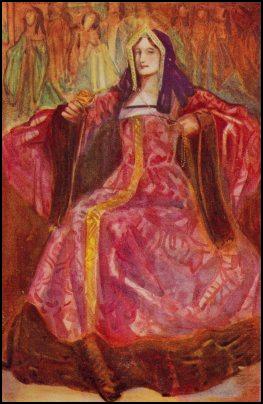
A WOMAN OF THE TIME OF HENRY VII - 1485-1509
This is a sumptuous gown in rich elaborate material - good stuff - not any old fabric. Notice the diamond-shaped head-dress, the wide, fur-edged gown with its full sleeves.
THE WOMEN
Take up a pack of cards and look at the queen.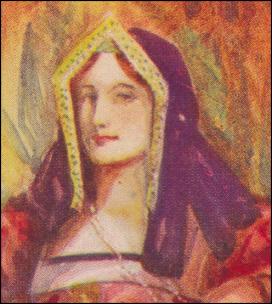
You may see the extraordinary head-gear as worn by ladies at the end of the fifteenth century and in the first years of the sixteenth, worn in a modified form all through the next reign, after which that description of head-dress vanished for ever, its place to be taken by caps, hats, and bonnets.
Early Tudor Caps, Bonnets, Hats, Headdresses, Coifs
The richest of these head-dresses were made of a black silk or some such black material, the top stiffened to the shape of a sloping house-roof, the edges falling by the face on either side - made stiff, so as to stand parallel - these were sewn with gold and pearls on colour or white.
The end of the hood hung over the shoulders and down the back; this was surmounted by a stole of stiffened material, also richly sewn with jewels, and the whole pinned on to a close-fitting cap of a different colour, the edge of which showed above the forehead.
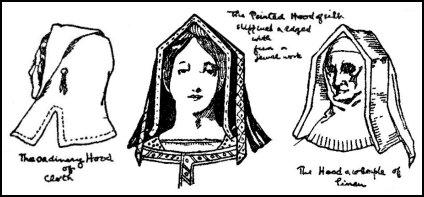
The more moderate head-dress was of black again, but in shape nearly square, and slit at the sides to enable it to hang more easily over the shoulders. It was placed over a coif, often of white linen or of black material, was turned over from the forehead, folded, and pinned back; often it was edged with gold.
On either side of the hood were hanging ornamental metal-tipped tags to tie back the hood from the shoulders, and this became, in time - that is, at the end of the reign - the ordinary manner of wearing them, till they were finally made up so.
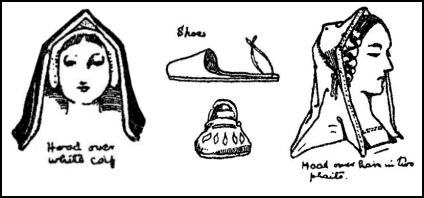
The ordinary head-dress was of white linen, crimped or embroidered in white, made in a piece to hang over the shoulders and down the back, folded back and stiffened in front to that peculiar triangular shape in fashion; this was worn by the older women over a white hood.
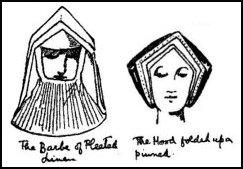
The plain coif, or close-fitting linen cap, was the most general wear for the poor and middle classes.
The hair was worn long and naturally over the shoulders by young girls, and plainly parted in the centre and dressed close to the head by women wearing the large head-dress.
Another form of head-dress, less common, was the turban - a loose bag of silk, gold and pearl embroidered, fitting over the hair and forehead tightly, and loose above.
THE WOMEN COSTUME
A WOMAN OF THE TIME OF HENRY VIII - 1509-1547
The woman wears a plain but rich looking dress and on her head a peculiar head-dress with a pad support of silk in front to hold it from the forehead. The half-sleeves are clearly visible.
The Hood
The final evolution of the hood....
Bit by bit, inch by inch, the plain fabric has become enriched, each succeeding step in an elaboration of the simple form; the border next to the face is turned back, then the hood is lined with fine stuff and the turnover shows this to advantage; then the sides are split and the back is made more full; then a tag is sewn on to the sides by which means the cut side may be fastened off the shoulders.
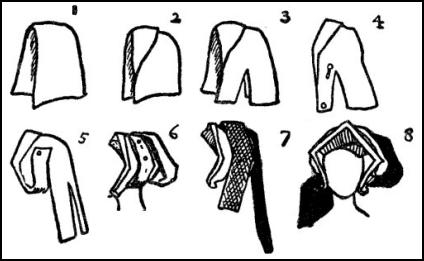
The front is now stiffened and shaped at an angle, this front is sewn with jewels, and, as the angle forms a gap between the forehead and the point of the hood, a pad is added to fill in the vacant space.
Diamond Shaped Tudor Headdress
At last one arrives at the diamond-shaped head-dress worn in this reign, and, in this reign, elaborated in every way, elaborated, in fact, out of existence.
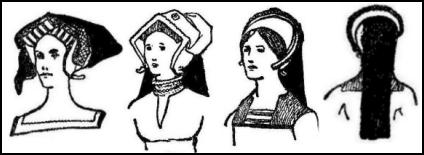
In order to make the head-dress in its 1509 state you must make the white lining with the jewelled turnover as a separate cap. However, I think that the drawings speak for themselves more plainly than I can write.
Every device for crowding jewels together was used, criss-cross, in groups of small numbers, in great masses.
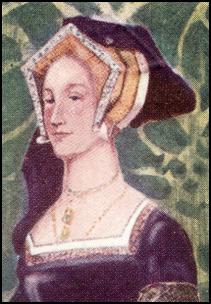
WOMAN OF THE TIME OF HENRY VIII - 1509-1547
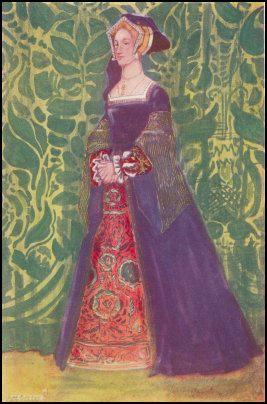
Notice the wide cuffs covered with gold network, and the rich panel of the under-skirt. Classical Henry VIII woman's costume.
German Coarse Gold-web Nets
One sees by the tortured and twisted German fashion that the hair was plaited, and so, in curves and twists, dropped into coarse gold-web nets, thrust into web nets with velvet pouches to them, so that the hair stuck out behind in a great knob, or at the side in two protuberances; over all a cap like to the man's, but that it was infinitely more feathered and jewelled.
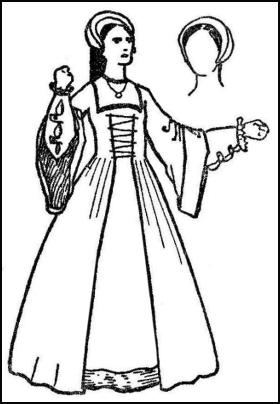
Barbes or Beard-like Linen Cloths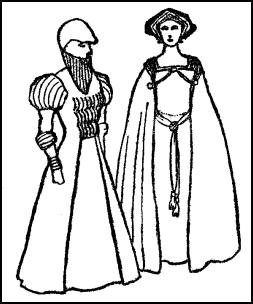
Then, again, they wore those hideous barbes or beard-like linen cloths, over the chin, and an infinite variety of caps of linen upon their heads - caps which showed always the form of the head beneath.
These hoods worn by the women, these wide sleeves to the gowns, these hanging sleeves to the overcoats, the velvet slip of under-dress, all, in their time, became falsified into ready-made articles.
With the hoods you can see for yourselves how they lend themselves by their shape to personal taste; they were made up, all ready sewn; where pins had been used, the folds of velvet at the back were made steadfast, the crimp of the white linen was determined, the angle of the side-flap ruled by some unwritten law of mode.
Mary Queen of Scots Head-dress
Elaborate Headdress Simplified 1550
In the end, by a process of evolution, the diamond shape disappeared, and the cap was placed further back on the head, the contour being circular where it had previously been pointed.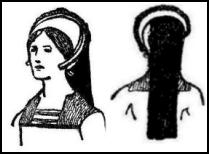
The velvet hanging-piece remained at the back of the head, but was smaller, in one piece, and was never pinned up, and the entire shape gradually altered towards, and finally into, the well-known Mary Queen of Scots head-dress, with which every reader must be familiar.
For the women, it may be said that the change towards simplicity is even more marked. The very elaborate head-dress, the folded, diamond-shaped French hood has disappeared almost entirely, and, for the rich, the half hoop, set back from the forehead with a piece of velvet or silk to hang down the back, will best describe the head-gear. From that to the centre-pointed hoop shows the trend of the shape.
A WOMAN OF THE TIME OF QUEEN MARY - 1553-1558
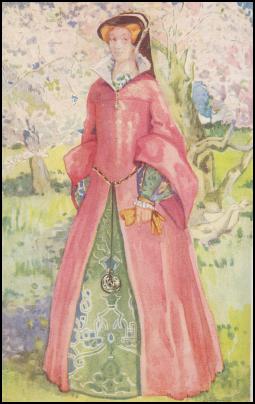
Wearing flowers in the opening of the dress was a frequent habit at this time. The fashion was begun in this reign. This dress lays the silhouette and styling of the later Elizabethan fashion which were an exaggeration of gowns such as this example.
The Hair
Ladies now show more hair, parted, as before, in the centre, but now puffed out at the sides.
The New 'Mary Style' Headdress
The new shape of head-dress becomes popular, and the upstanding collar to the gown is almost universal.
The Neat Linen Caps
Women wear neat linen caps, made very plain and close to the head, with small ear-pieces.
On the shoulders there is a fashion of wearing kerchiefs of linen or silk, white as a rule; white, in fact, is frequently used for dresses, both for men and women.
Towards Elizabethan Dress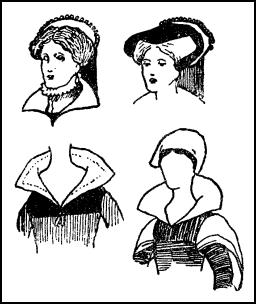
Calthrop continues:-
You will realize that to one born in the reign of Henry VIII the appearance of people now was very different, and, to anyone as far away as we are now, the intervening reigns of Edward and Mary are interesting as showing the wonderful quiet change that could take place in those few years, and alter man's exterior from the appearance of a playing-card, stiff, square, blob-footed, to the doublet and hose person with a cart-wheel of a ruff, which recalls to us Elizabethan dress.
ELIZABETH I COSTUME - 1558-1603 THE WOMEN
Hoops & Hair
Now this is the reign of the ruff and the monstrous hoop and the wired hair.
As a companion to her lord, who came from the hands of his barber with his hair after the Italian manner, short and round and curled in front and frizzed, or like a Spaniard, long hair at his ears curled at the two ends, or with a French love-lock dangling down his shoulders, she - his lady - sits under the hands of her maid, and tries various attires of false hair, principally of a yellow colour.
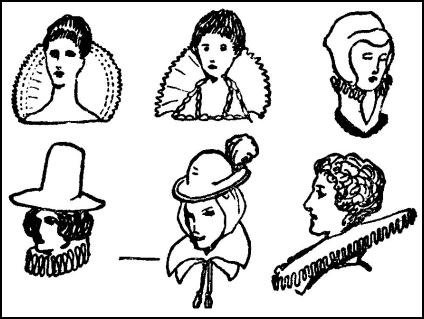
Every now and again she consults the looking-glass hanging on her girdle; sometimes she dresses her hair with chains of gold, from which jewels or gold-work tassels hang; sometimes she, too, allows a love-lock to rest upon her shoulder, or fall negligently on her ruff.
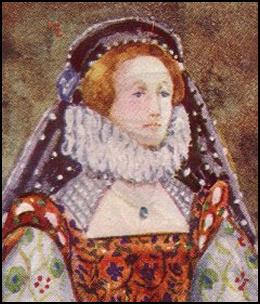
Elizabethan Headdress & Ruff
Openwork Lace Bonnet
The openwork lace bonnet, of the shape so well known by the portraits of Queen Mary of Scotland, is not possible to exactly describe in writing; one variety of it may be seen in the line drawing given. It is made of cambric and cut lace sewn on to wires bent into the shape required.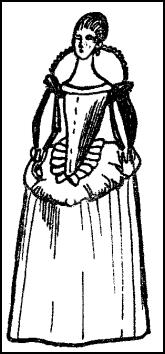
In such a time of extravagance in fashion the additions one may make to any form of dress in the way of ribbons, bows, sewn pearls, cuts, slashes, and puffs are without number.
Elizabethan Women's Hair Accessories
The hair, for example, can be dressed with pearls, rings of gold, strings of pearls, feathers, or glass ornaments. Men and women wore monstrous earrings, but curiously enough this fashion was more common to men than women.
Ladies Hats
Hats were interchangeable, more especially the trim hat with a feather, in shape like those worn by the Yeoman of the Guard, but smaller.
The shoulder pinions of the jerkins were puffed, slashed, and beribboned in every way.
The wing sleeves, open from the shoulder all the way down, were so long sometimes as to reach the ground, and were left hanging in front, or thrown back over the shoulders, the better to display the rich under-sleeve.
Masked Ladies
Ladies went masked about the streets and in the theatres, or if they wished to be unconventional, they sat in the playing booths unmasked, their painted faces exposed to the public gaze.
THE WOMEN.
A Jacobean Lady's Wardrobe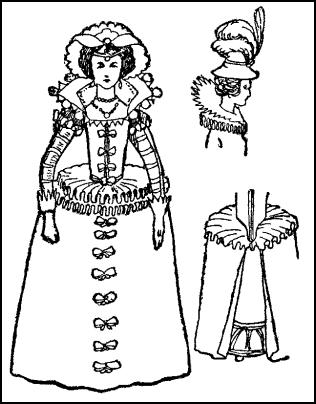
She is taking more readily to the man's hat, feathered and banded, and in so doing is forced to dress her hair more simply and do away with jewellery on her forehead; but, as is often the case, she dresses her hair with plumes and jewels and little linen or lace ruffs, and atop of all wears a linen cap with side wings to it and a peak in the centre.
Her ruff is now, most generally, in the form of an upstanding collar to her dress, open in front, finishing on her shoulders with some neat bow or other ornament.
It is of lace of very fine workmanship, edged plain and square, or in all manner of fancy scallops, circles, and points.
Sometimes she will wear both ruff and collar, the ruff underneath to prop up her collar at the back to the required modish angle.
Sometimes her bodice will finish off in a double Catherine-wheel.
A WOMAN OF THE TIME OF JAMES I -1603-1625
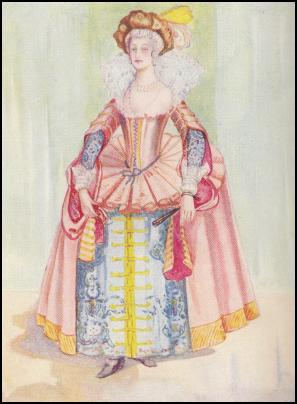
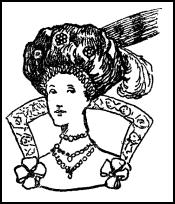
A Woman in the Time of James 1.
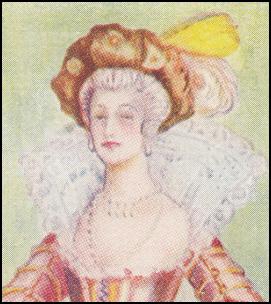
A Woman in the Time of James 1.
As the reign died, so did its fashions die also: padded breeches lost some of their bombast, ruffs much of their starch, and fardingales much of their circumference, and the lady became more Elizabethan in appearance, wore a roll under her hair in front, and a small hood with a jewelled frontlet on her forehead.
It was the last of the Tudor dress, and came, as the last flicker of a candle, before the new mode, Fashion's next footstep.
The Lady's Maid
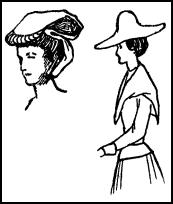 Her maid is a deal more simple; her hair is dressed very plainly, a loop by the ears, a twist at the nape of the neck. She has a shawl over her shoulders, or a broad falling collar of white linen.
She has no fardingale, but her skirts are full. Her bodice fits, but is not stiffened artificially; her sleeves are tight and neat, and her cuffs plain. Upon her head is a broad-brimmed plain hat.
On the next page you can read and see Calthrop's opinions on hairstyles and headdresses of women from 1625.
This costume history page is about hair fashion history. It consists of a selection of women only headdresses and hairstyles from the Tudor/Elizabethan eras with illustrations and original text from Calthrop's English Costume.
The illustrations are also shown in individual Calthrop costume pages for specific eras on 36 other pages in another section of this website. The partial text copy is from the book ENGLISH COSTUME PAINTED & DESCRIBED BY DION CLAYTON CALTHROP. Full text is on the individual dated pages.
This page is about female headdresses and hairstyles for the medieval era 1485-1600. Later eras of hairdressing and headdresses are shown on other pages. For the Introduction to this book see this introduction written by Dion Clayton Calthrop.
My comments are in italics.
Page Added January 2011. Ref:-P773.

