Edited By Pauline Weston Thomas for Fashion-Era.com
This section looks at the English Costume book by Dion Clayton Calthrop. It describes the history of English gowns, tunics, headwear, pants, jackets, robes and other basic styles. The costume history includes 700 years of everyday costume worn in England between 1066 and 1820. Dates and names of every English King and Queen between 1066 and 1830 is included.
Use the costume images as guides for Medieval/Middle Ages re-enactment, fancy dress, carnivals, pageants and dramas. The timeline covers for example William The Conqueror, the King John, Robin Hood era, Country Folk, Edward III, Chaucer, Henry VIII, Elizabeth 1, Cromwellians, Charles II, Georgian Kings & Beau Brummell.
Ancient Costume before the second millennium period is shown in Egyptian, Greek and Roman Costume - a different section.
The colouring in sheets are suitable for school use.
Introduction
Editor note - There can be few devotees of early English costume history who have not seen a copy of the early C20th work entitled:-
ENGLISH COSTUME
PAINTED & DESCRIBED BY
DION CLAYTON CALTHROP.
You can see all of the images shown on this page enlarged more and with many more extra colouring drawings for every reign of English Costume by looking at the individual pages on site. Use the gold sidebar or links at the bottom of every Calthrop page, view the sitemap or use the search facility to navigate to a Calthrop era of interest.
I love my battered old wine leather bound tomb of a book with art nouveau patterns impressed on the cover. As a little girl I would leaf my way through this book to find the coloured costume plates of the pretty dresses the ladies wore.
I've never been so interested in male costume, but it was clear to me even then some of the garments the men were depicted wearing in the book plates were frequently just as handsome ensembles as the ladies garb.
Of course all the costume in the book is pre1830 so dress for men was relatively more flamboyant. This website is about female dress history, but by putting the bulk of this book online I have the opportunity to show you some male dress from eras I would not normally cover, whilst I also continue with my personal passion for adding more female costume.
You can see all of the images shown on this page and many more by looking at the individual pages.
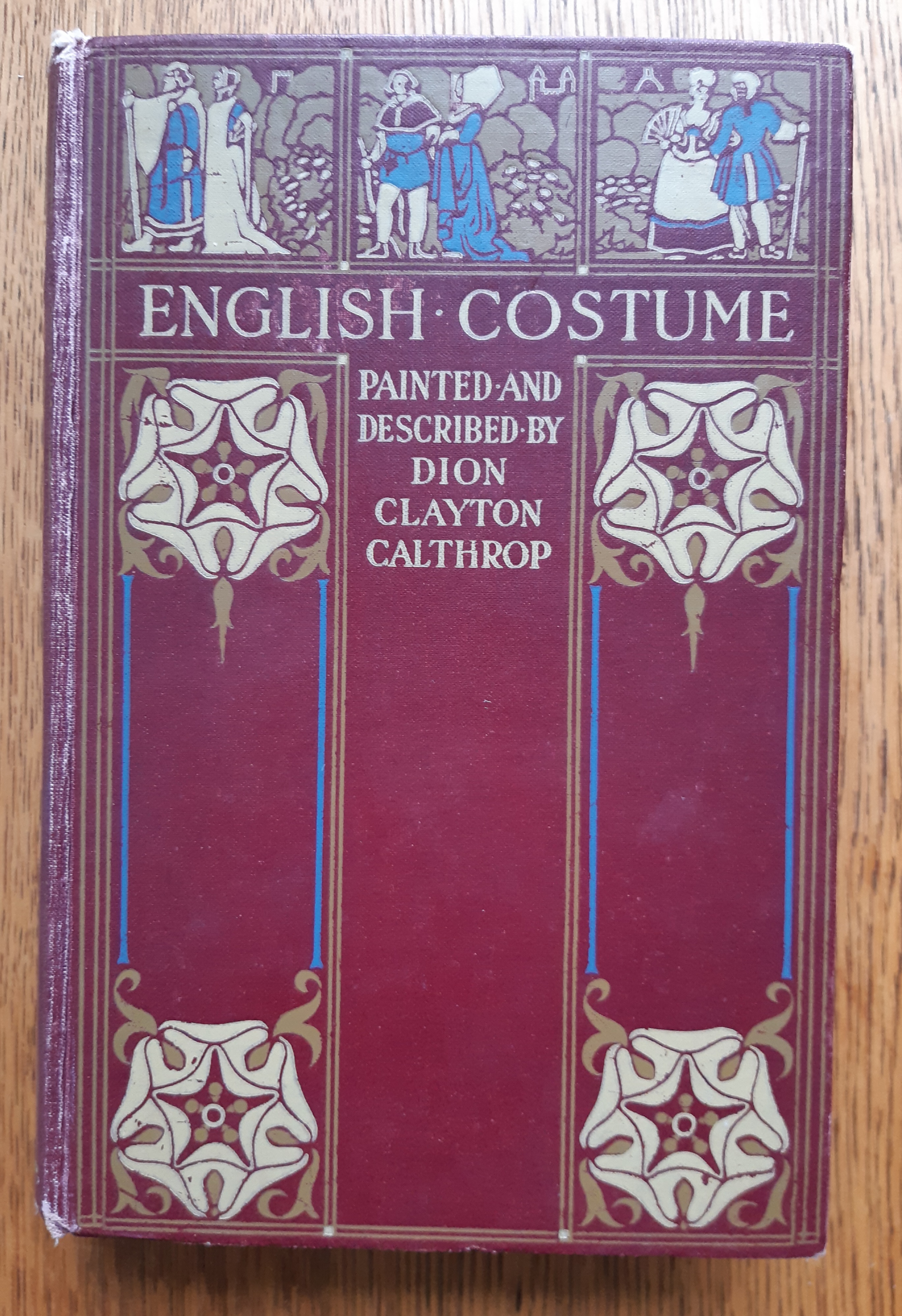
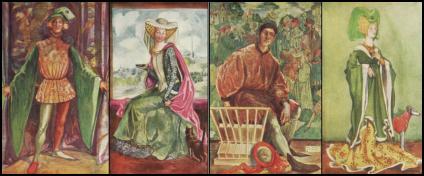
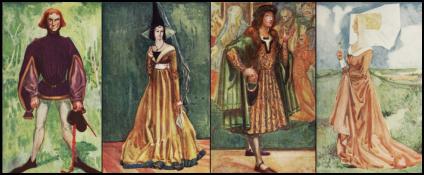
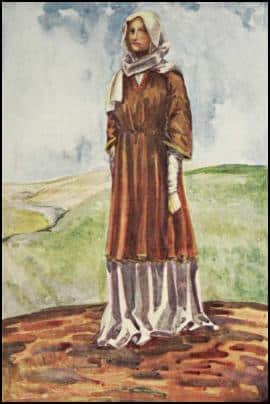
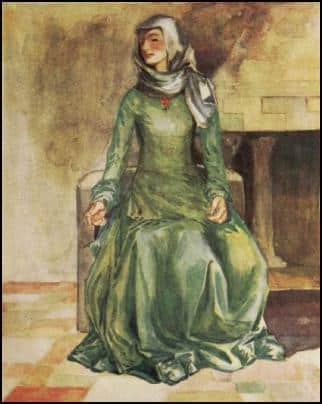
This 36 page section on fashion-era.com consists of a text copy of the book ENGLISH COSTUME PAINTED & DESCRIBED BY DION CLAYTON CALTHROP. Visuals, drawings and painted fashion plates in the book have a charm of their own and are shown amid the text. The book covers both male and female dress history of over 700 years spanning the era 1066-1830.
DION CLAYTON CALTHROP lived 1875 to 1937 and I am struck how his philosophy of life shines through this book in his closing book introduction paragraph he states:-
"The book is intended to be read, and is not wrapped up in grandiose phrases and a great wind about nothing; I would wish to be thought more friendly than the antiquarian and more truthful than the historian, and so have endeavoured to show, in addition to the body of the clothes, some little of their soul." I really love this attitude since I also believe clothes never live in isolation of a person and their daily circumstances. We can read many messages into them and the character of the people who wore them. Lets take a look at Impresario Dion Clayton Calthrop's opinion of costume history and written in his own words over 100 years ago.
Published in four volumes during 1906.
Reissued in one volume, April, 1907.A MAN OF THE TIME OF GEORGE IV
The book begins with an INTRODUCTION and this illustration of A Man Of the Time - George IV 1820-1830 - Image Right.
Here you see the coat which we now wear, slightly altered, in out evening dress. If came into fashion, with this form of top-boots, in 1799, and was called Jean-de-Bry. Notice the commencement of the whisker fashion.
The text of this introduction is below.
Also known as William The Conqueror.
Costume for Men and Women 1066-1087. Tunics, cross gartering, girdles, gowns and wimples. Images.
William The Second 1087-1100
Costume for Men and Women 1087-1100.
Medieval hair and plaits.
Page Added 5 August 2010
Henry The First 1100-1135
Henry The First 1100-1135. Costume for Men and Women in C12th Britain. Tunics, cross gartering, girdles, gowns and wimples. Images.
Stephen - 1135-1154
King Stephen. Costume for Men and Women in C12th Britain. Tunics, plaits and wimples. Images.
Henry The Second 1154-1189
Medieval chin bands, caps, wimples for women.
Page Added 5 August 2010
Richard The First 1189-1199
Long flowing gowns and capacious mantles. Oriental influences on dress in the Middle Ages.
Page Added 5 August 2010
John 1199-1216
Colourful Medieval Surcoats, cloaks and mantles. Big sleeves.
Page Added 5 August 2010
Henry The Third 1216-1272
The surcoat and interesting pointed shoes of the Middle Ages.
Costume - End of the Fourteenth Century 1066-1272
The Country Folk. Early Medieval peasant clothing and dress. The mole-catcher.
Page Added 5 August 2010
Edward The First 1272 -1307
Edward I and Queen Eleanor in the Middle Ages.
Page Added 5 August 2010
Edward The Second 1307 - 1327
The new cotehardie, the Medieval liripipe and fillet hairdressing.
Page Added 5 August 2010
Edward The Third - 1327-1377
Ladies Surcoats - lirippe, sleeve tippet, gorget, wimple, fillet, women's head-dress, cotehardie. Scalloped capes, purses, parti-colours. Courtiers. Piers Plowman Poem. Loutrell Psalter - illuminated manuscripts. The Third Great Pestilence. Kings cavalcade.
Page Added 7 August 2010
Richard The Second - 1377-1399
The Houppelande. Ladies Surcoats. Cotehardie The Chaperon. Caul fillet headdress. Pointy Toe shoes. Men and women's dress in late medieval England.
Page Added 7 August 2010
The End Of The Fourteenth Century - Dress by Chaucer
Chaucer's descriptions of everyday Medieval dress worn by pilgrims in his Canterbury Tales. Extracts - The Miller's Tale and The Parson's Tale. Colouring-in pictures.
Page Added 8 August 2010
Henry The Fourth - 1399-1415
Houppelandes, Surcoats and Cotehardies.
Page Added 10 August 2010
Henry The Fifth - 1413-1422
Dress at the time of the Battle of Agincourt. The man's short houppelande gown, the hood and the sugar-bag cap. Baldrick belt and priest cropped hair.
Page Added 11 August 2010
Henry The Sixth - 1422-1461
The full sleeved tunic for men and the elaborate headdresses for women.
Page Added 11 August 2010
Edward The Fourth - 1461-1483
The steeple headdress reaches new heights for women.
Men's tunics are cropped short and worn with hosiery, but new styles are emerging.
Page Added 12 August 2010
Richard The Third - 1483-1485
Medievalism draws to a close and old fashion styles die whilst the basis of the Tudor trend style is set.
Edward The Fifth - He reigned just two months April and June 1487. No Page
Page Added 13 August 2010
Henry The Seventh - 1485-1509
The new Tudor dynasty begins.
Slashed sleeves, the dressing gown coat and coif hood headdresses all in rich luxuriant materials - 'good stuff' dominate styles.
Page Added 14 August 2010
Henry The Eighth - 1509-1547
House of Tudor. Dress for men and women during the reign of Henry VIII and his 6 wives.
The white hood, the diamond arch headdress, slashed and blistered sleeves. Colouring-in drawings.
Edward The Sixth - 1547-1553
The important flat cap and tunic to doublet for men. Women's simpler headwear and larger collars. Transitioning toward Elizabethan styling.
Mary - 1553 -1558
The Spanish influence on dress in the mid 16th century. The transition from Tudor to Elizabethan styles and silhouettes.
Elizabeth - 1558-1603
45 Years of fashion history during the reign of Queen Elizabeth I. Doublet, trunks, hose, ruffs, collars, slashed sleeves.
Shakespeare and clothes.
James The First - 1603-1625
Jacobean Costume.
Jacobean Hair Styles
Ladies Hairstyles & Headdresses as Shown in
'English Costume History by Dion Clayton Calthrop'
Charles The First - 1625-1649
Charles I.
Cavalier dress for men and women. the decline of the ruff. The development of the doublet. The popularity of the Vandyke collar.
Hollar Drawings Index
The Cromwells - 1649-1660
Dress During the Civil War Era. Plainer garment styles without frippery.
Charles The Second - 1660-1685
Restoration costume for men is fussy, extravagant and not very practical featuring lace, ribbons and huge wigs.
There were two distinct forms of dress for men in the reign of Charles II - the short and later the longer jacket which developed into the frock coat.
James The Second - 1685-1689
William And Mary - 1689-1702
Queen Anne - 1702-1714
Hollar Drawings
Hollar English Costume Plates Page 1
Hollar English Costume Plates Page 2
Hollar English Costume Plates Page 3
Hollar English Costume Plates Page 4
Hollar English Costume Plates Page 5
George The First - 1714-1727
George The Second - 1727 -1760
The Georgian Frock Coat. wigs
George The Third - 1760-1820
Men's Coats Drawings by Calthrop
1760-1820 George III - Men's Occupational Dress
Drawings by Calthrop

 This section looks at the English Costume book by Dion Clayton Calthrop. It describes the history of English gowns, tunics, headwear, pants, jackets, robes and other basic styles. The costume history includes 700 years of everyday costume worn in England between 1066 and 1820. Dates and names of every English King and Queen between 1066 and 1830 is included.
Use the costume images as guides for Medieval/Middle Ages re-enactment, fancy dress, carnivals, pageants and dramas. The timeline covers for example William The Conqueror, the King John, Robin Hood era, Country Folk, Edward III, Chaucer, Henry VIII, Elizabeth 1, Cromwellians, Charles II, Georgian Kings & Beau Brummell.
Ancient Costume before the second millennium period is shown in Egyptian, Greek and Roman Costume - a different section.
The colouring in sheets are suitable for school use.
This section looks at the English Costume book by Dion Clayton Calthrop. It describes the history of English gowns, tunics, headwear, pants, jackets, robes and other basic styles. The costume history includes 700 years of everyday costume worn in England between 1066 and 1820. Dates and names of every English King and Queen between 1066 and 1830 is included.
Use the costume images as guides for Medieval/Middle Ages re-enactment, fancy dress, carnivals, pageants and dramas. The timeline covers for example William The Conqueror, the King John, Robin Hood era, Country Folk, Edward III, Chaucer, Henry VIII, Elizabeth 1, Cromwellians, Charles II, Georgian Kings & Beau Brummell.
Ancient Costume before the second millennium period is shown in Egyptian, Greek and Roman Costume - a different section.
The colouring in sheets are suitable for school use.
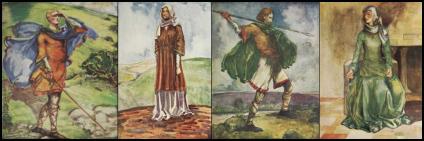
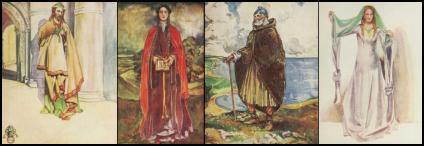
 I've never been so interested in male costume, but it was clear to me even then some of the garments the men were depicted wearing in the book plates were frequently just as handsome ensembles as the ladies garb.
Of course all the costume in the book is pre1830 so dress for men was relatively more flamboyant. This website is about female dress history, but by putting the bulk of this book online I have the opportunity to show you some male dress from eras I would not normally cover, whilst I also continue with my personal passion for adding more female costume.
You can see all of the images shown on this page and many more by looking at the individual pages.
This 36 page section on fashion-era.com consists of a text copy of the book ENGLISH COSTUME PAINTED & DESCRIBED BY DION CLAYTON CALTHROP. Visuals, drawings and painted fashion plates in the book have a charm of their own and are shown amid the text. The book covers both male and female dress history of over 700 years spanning the era 1066-1830.
DION CLAYTON CALTHROP lived 1875 to 1937 and I am struck how his philosophy of life shines through this book in his closing book introduction paragraph he states:-
"The book is intended to be read, and is not wrapped up in grandiose phrases and a great wind about nothing; I would wish to be thought more friendly than the antiquarian and more truthful than the historian, and so have endeavoured to show, in addition to the body of the clothes, some little of their soul." I really love this attitude since I also believe clothes never live in isolation of a person and their daily circumstances. We can read many messages into them and the character of the people who wore them. Lets take a look at Impresario Dion Clayton Calthrop's opinion of costume history and written in his own words over 100 years ago.
I've never been so interested in male costume, but it was clear to me even then some of the garments the men were depicted wearing in the book plates were frequently just as handsome ensembles as the ladies garb.
Of course all the costume in the book is pre1830 so dress for men was relatively more flamboyant. This website is about female dress history, but by putting the bulk of this book online I have the opportunity to show you some male dress from eras I would not normally cover, whilst I also continue with my personal passion for adding more female costume.
You can see all of the images shown on this page and many more by looking at the individual pages.
This 36 page section on fashion-era.com consists of a text copy of the book ENGLISH COSTUME PAINTED & DESCRIBED BY DION CLAYTON CALTHROP. Visuals, drawings and painted fashion plates in the book have a charm of their own and are shown amid the text. The book covers both male and female dress history of over 700 years spanning the era 1066-1830.
DION CLAYTON CALTHROP lived 1875 to 1937 and I am struck how his philosophy of life shines through this book in his closing book introduction paragraph he states:-
"The book is intended to be read, and is not wrapped up in grandiose phrases and a great wind about nothing; I would wish to be thought more friendly than the antiquarian and more truthful than the historian, and so have endeavoured to show, in addition to the body of the clothes, some little of their soul." I really love this attitude since I also believe clothes never live in isolation of a person and their daily circumstances. We can read many messages into them and the character of the people who wore them. Lets take a look at Impresario Dion Clayton Calthrop's opinion of costume history and written in his own words over 100 years ago.
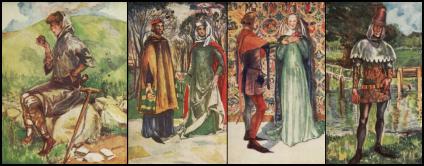

 As you will see, I have devoted myself entirely to civil costume - that is, the clothes a man or a woman would wear from choice, and not by reason of an appointment to some ecclesiastical post, or to a military calling, or to the Bar, or the Bench. Such clothes are but symbols of their trades and professions, and have been dealt with by persons who specialize in those professions. I have taken the date of the Conquest as my starting-point, and from that date -a very simple period of clothes I have followed the changes of the garments reign by reign, fold by fold, button by button, until we arrive quite smoothly at Beau Brummell, the inventor of modern clothes, the prophet of cleanliness.
 I have taken considerable pains to trace the influence of one garment upon its successor, to reduce the wardrobe for each reign down to its simplest cuts and folds, so that the reader may follow quite easily the passage of the coat from its birth to its ripe age, and by this means may not only know the clothes of one time, but the reasons for those garments. To the best of my knowledge, such a thing has never been done before; most works on dress try to include the world from Adam to Charles Dickens, lump a century into a page, and dismiss the ancient Egyptians in a couple of colour plates.
 So many young gentlemen have blown away their patrimony on feathers and tobacco that it is necessary for us to confine ourselves to certain gentlemen and ladies in out own country. A knowledge of history is essential to the study of mankind, and a knowledge of history is never perfect without a knowledge of the clothes with which to dress it.
A man, in a sense, belongs to his clothes; they are so much a part of him that, to take him seriously, one must know how he walked about, in what habit, with what air. I am compelled to speak strongly of my own work because I believe in it, and I feel that the series of paintings in these volumes are really a valuable addition to English history. To be modest is often to be excessively vain, and, having made an exhaustive study of my subject from my own point of view, I do not feel called upon to hide my knowledge under a bushel. Of course, I do not suggest that the ordinary cultured man should acquire the same amount of knowledge as a painter, or a writer of historical subjects, or an actor, but he should understand the clothes of his own people, and be able to visualize any date in which he may be interested.
So many young gentlemen have blown away their patrimony on feathers and tobacco that it is necessary for us to confine ourselves to certain gentlemen and ladies in out own country. A knowledge of history is essential to the study of mankind, and a knowledge of history is never perfect without a knowledge of the clothes with which to dress it.
A man, in a sense, belongs to his clothes; they are so much a part of him that, to take him seriously, one must know how he walked about, in what habit, with what air. I am compelled to speak strongly of my own work because I believe in it, and I feel that the series of paintings in these volumes are really a valuable addition to English history. To be modest is often to be excessively vain, and, having made an exhaustive study of my subject from my own point of view, I do not feel called upon to hide my knowledge under a bushel. Of course, I do not suggest that the ordinary cultured man should acquire the same amount of knowledge as a painter, or a writer of historical subjects, or an actor, but he should understand the clothes of his own people, and be able to visualize any date in which he may be interested.
 One half of the people who talk glibly of Beau Brummell have but half an idea when he lived, and no idea that, for example, he wore whiskers.
Hamlet they can conjure up, but would have some difficulty in recognising Shakespeare, because most portraits of him are but head and shoulders. Napoleon has stamped himself on men's minds very largely through the medium of a certain form of hat, a lock of hair, and a gray coat.
In future years an orchid will be remembered as an emblem. I have arranged, as far as it is possible, that each plate shall show the emblem or distinguishing mark of the reign it illustrates, so that the continuity of costume shall be remembered by the arresting notes.
One half of the people who talk glibly of Beau Brummell have but half an idea when he lived, and no idea that, for example, he wore whiskers.
Hamlet they can conjure up, but would have some difficulty in recognising Shakespeare, because most portraits of him are but head and shoulders. Napoleon has stamped himself on men's minds very largely through the medium of a certain form of hat, a lock of hair, and a gray coat.
In future years an orchid will be remembered as an emblem. I have arranged, as far as it is possible, that each plate shall show the emblem or distinguishing mark of the reign it illustrates, so that the continuity of costume shall be remembered by the arresting notes.
 As the fig-leaf identifies Adam, so may the chaperon twisted into a cockscomb mark Richard II. As the curled and scented hair of Alcibiades occurs to our mind, so shall Beau Nash manage his clouded cane.
Elizabeth shall be helped to the memory by her Piccadilly ruff; square Henry VIII by his broad-toed shoes and his little fiat cap; Anne Boleyn by her black satin nightdress; James be called up as padded trucks; Maximilian as puffs and slashes; D'Orsay by the curve of his hat; Tennyson as a dingy brigand; Gladstone as a collar; and even more recent examples, as the Whistlerian lock and the Burns blue suit.
As the fig-leaf identifies Adam, so may the chaperon twisted into a cockscomb mark Richard II. As the curled and scented hair of Alcibiades occurs to our mind, so shall Beau Nash manage his clouded cane.
Elizabeth shall be helped to the memory by her Piccadilly ruff; square Henry VIII by his broad-toed shoes and his little fiat cap; Anne Boleyn by her black satin nightdress; James be called up as padded trucks; Maximilian as puffs and slashes; D'Orsay by the curve of his hat; Tennyson as a dingy brigand; Gladstone as a collar; and even more recent examples, as the Whistlerian lock and the Burns blue suit.
 And what romantic incidents may we not hang upon out clothes-line! The cloak of Samuel Pepys (' Dapper Dick,' as he signed himself to a certain lady) sheltering four ladies from the rain ; Sir Walter Raleigh spreading his cloak over the mud to protect the shoes of that great humorist Elizabeth (I never think of her apart from the saying, 'Ginger for pluck'); Mary, Queen of Scots, ordering false attires of hair during her captivity - all these scenes clinched into reality by the knowledge of the dress proper to them.
And what are we doing to help modern history - the picture of our own times - that it may look beautiful in the ages to come ? I cannot answer you that.
Some chapters of this work have appeared in the Connoisseur, and I have to thank the editor for his courtesy in allowing me to reproduce them. I must also thank Mr. Pownall for his help in the early stages of my labours. One thing more I must add: I do not wish this book to go forth and be received with that frigid politeness which usually welcomes a history to the shelves of the bookcase, there to remain unread.
The book is intended to be read, and is not wrapped up in grandiose phrases and a great wind about nothing; I would wish to be thought more friendly than the antiquarian and more truthful than the historian, and so have endeavoured to show, in addition to the body of the clothes, some little of their soul.
DION CLAYTON CALTHROP.
Illustrations in Colour - 1. A Man of the Time of George IV. 1820-1830 Shown in the Book Frontispiece.
If you like this book you can probably find a copy on EBay or Amazon at reasonable cost. I recently bought a copy for a friend who liked the authenticity and handle of my 100 year old book. I paid under £10 for the old copy for her. A leather bound book like this gives many people great pleasure in a similar way to downloaders to iPods. The same yet different. If you are more erudite in your approach and collect first edition books you may prefer to pay Antiquarian book prices at £100+.
You have been reading the introduction to the Dion Clayton Calthrop English Costume History article at www.fashion-era.com ©
Page Added August 2010.
And what romantic incidents may we not hang upon out clothes-line! The cloak of Samuel Pepys (' Dapper Dick,' as he signed himself to a certain lady) sheltering four ladies from the rain ; Sir Walter Raleigh spreading his cloak over the mud to protect the shoes of that great humorist Elizabeth (I never think of her apart from the saying, 'Ginger for pluck'); Mary, Queen of Scots, ordering false attires of hair during her captivity - all these scenes clinched into reality by the knowledge of the dress proper to them.
And what are we doing to help modern history - the picture of our own times - that it may look beautiful in the ages to come ? I cannot answer you that.
Some chapters of this work have appeared in the Connoisseur, and I have to thank the editor for his courtesy in allowing me to reproduce them. I must also thank Mr. Pownall for his help in the early stages of my labours. One thing more I must add: I do not wish this book to go forth and be received with that frigid politeness which usually welcomes a history to the shelves of the bookcase, there to remain unread.
The book is intended to be read, and is not wrapped up in grandiose phrases and a great wind about nothing; I would wish to be thought more friendly than the antiquarian and more truthful than the historian, and so have endeavoured to show, in addition to the body of the clothes, some little of their soul.
DION CLAYTON CALTHROP.
Illustrations in Colour - 1. A Man of the Time of George IV. 1820-1830 Shown in the Book Frontispiece.
If you like this book you can probably find a copy on EBay or Amazon at reasonable cost. I recently bought a copy for a friend who liked the authenticity and handle of my 100 year old book. I paid under £10 for the old copy for her. A leather bound book like this gives many people great pleasure in a similar way to downloaders to iPods. The same yet different. If you are more erudite in your approach and collect first edition books you may prefer to pay Antiquarian book prices at £100+.
You have been reading the introduction to the Dion Clayton Calthrop English Costume History article at www.fashion-era.com ©
Page Added August 2010.
.jpg) King Stephen. Costume for Men and Women in C12th Britain. Tunics, plaits and wimples. Images.
King Stephen. Costume for Men and Women in C12th Britain. Tunics, plaits and wimples. Images.

 Medieval chin bands, caps, wimples for women.
Page Added 5 August 2010
Medieval chin bands, caps, wimples for women.
Page Added 5 August 2010
 Long flowing gowns and capacious mantles. Oriental influences on dress in the Middle Ages.
Page Added 5 August 2010
Long flowing gowns and capacious mantles. Oriental influences on dress in the Middle Ages.
Page Added 5 August 2010
.jpg) Colourful Medieval Surcoats, cloaks and mantles. Big sleeves.
Page Added 5 August 2010
Colourful Medieval Surcoats, cloaks and mantles. Big sleeves.
Page Added 5 August 2010
 The surcoat and interesting pointed shoes of the Middle Ages.
 Page Added 5 August 2010
 Edward I and Queen Eleanor in the Middle Ages.
Page Added 5 August 2010
Edward I and Queen Eleanor in the Middle Ages.
Page Added 5 August 2010
 Page Added 5 August 2010

 Ladies Surcoats - lirippe, sleeve tippet, gorget, wimple, fillet, women's head-dress, cotehardie. Scalloped capes, purses, parti-colours. Courtiers. Piers Plowman Poem. Loutrell Psalter - illuminated manuscripts. The Third Great Pestilence. Kings cavalcade.
Page Added 7 August 2010
Ladies Surcoats - lirippe, sleeve tippet, gorget, wimple, fillet, women's head-dress, cotehardie. Scalloped capes, purses, parti-colours. Courtiers. Piers Plowman Poem. Loutrell Psalter - illuminated manuscripts. The Third Great Pestilence. Kings cavalcade.
Page Added 7 August 2010

 The Houppelande. Ladies Surcoats. Cotehardie The Chaperon. Caul fillet headdress. Pointy Toe shoes. Men and women's dress in late medieval England.
Page Added 7 August 2010
The Houppelande. Ladies Surcoats. Cotehardie The Chaperon. Caul fillet headdress. Pointy Toe shoes. Men and women's dress in late medieval England.
Page Added 7 August 2010
 Chaucer's descriptions of everyday Medieval dress worn by pilgrims in his Canterbury Tales. Extracts - The Miller's Tale and The Parson's Tale. Colouring-in pictures.
Page Added 8 August 2010
Henry The Fourth - 1399-1415
Chaucer's descriptions of everyday Medieval dress worn by pilgrims in his Canterbury Tales. Extracts - The Miller's Tale and The Parson's Tale. Colouring-in pictures.
Page Added 8 August 2010
Henry The Fourth - 1399-1415
 Houppelandes, Surcoats and Cotehardies.
Page Added 10 August 2010
Houppelandes, Surcoats and Cotehardies.
Page Added 10 August 2010

 Dress at the time of the Battle of Agincourt. The man's short houppelande gown, the hood and the sugar-bag cap. Baldrick belt and priest cropped hair.
Page Added 11 August 2010
Dress at the time of the Battle of Agincourt. The man's short houppelande gown, the hood and the sugar-bag cap. Baldrick belt and priest cropped hair.
Page Added 11 August 2010

 The full sleeved tunic for men and the elaborate headdresses for women.
Page Added 11 August 2010
The full sleeved tunic for men and the elaborate headdresses for women.
Page Added 11 August 2010

 The steeple headdress reaches new heights for women.
Men's tunics are cropped short and worn with hosiery, but new styles are emerging.
Page Added 12 August 2010
The steeple headdress reaches new heights for women.
Men's tunics are cropped short and worn with hosiery, but new styles are emerging.
Page Added 12 August 2010

 Medievalism draws to a close and old fashion styles die whilst the basis of the Tudor trend style is set.
Edward The Fifth - He reigned just two months April and June 1487. No Page
Page Added 13 August 2010
Medievalism draws to a close and old fashion styles die whilst the basis of the Tudor trend style is set.
Edward The Fifth - He reigned just two months April and June 1487. No Page
Page Added 13 August 2010

 The new Tudor dynasty begins.
Slashed sleeves, the dressing gown coat and coif hood headdresses all in rich luxuriant materials - 'good stuff' dominate styles.
Page Added 14 August 2010
The new Tudor dynasty begins.
Slashed sleeves, the dressing gown coat and coif hood headdresses all in rich luxuriant materials - 'good stuff' dominate styles.
Page Added 14 August 2010

 The white hood, the diamond arch headdress, slashed and blistered sleeves. Colouring-in drawings.
 The important flat cap and tunic to doublet for men. Women's simpler headwear and larger collars. Transitioning toward Elizabethan styling.

 The Spanish influence on dress in the mid 16th century. The transition from Tudor to Elizabethan styles and silhouettes.
.jpg)
 45 Years of fashion history during the reign of Queen Elizabeth I. Doublet, trunks, hose, ruffs, collars, slashed sleeves.
Shakespeare and clothes.
45 Years of fashion history during the reign of Queen Elizabeth I. Doublet, trunks, hose, ruffs, collars, slashed sleeves.
Shakespeare and clothes.

 Jacobean Costume.

 Charles I.
Cavalier dress for men and women. the decline of the ruff. The development of the doublet. The popularity of the Vandyke collar.
Charles I.
Cavalier dress for men and women. the decline of the ruff. The development of the doublet. The popularity of the Vandyke collar.

 Dress During the Civil War Era. Plainer garment styles without frippery.


 Restoration costume for men is fussy, extravagant and not very practical featuring lace, ribbons and huge wigs.
There were two distinct forms of dress for men in the reign of Charles II - the short and later the longer jacket which developed into the frock coat.
Restoration costume for men is fussy, extravagant and not very practical featuring lace, ribbons and huge wigs.
There were two distinct forms of dress for men in the reign of Charles II - the short and later the longer jacket which developed into the frock coat.


 The Georgian Frock Coat. wigs

 Men's Coats Drawings by Calthrop
1760-1820 George III - Men's Occupational Dress
Drawings by Calthrop
Men's Coats Drawings by Calthrop
1760-1820 George III - Men's Occupational Dress
Drawings by Calthrop


