King Henry V Costume History 1413-1422 Pictures and Text by Dion Clayton Calthrop
 This costume history information consists of Pages 161-175 of the chapter on 15th century dress in the 9 year reign of King Henry The Fifth 1413-1422 and taken from English Costume by Dion Clayton Calthrop.
For the Introduction to this book see this introduction written by Dion Clayton Calthrop. I have adjusted the images so they can be used for colouring worksheets where pupils add some costume/society facts.
My comments are in italics.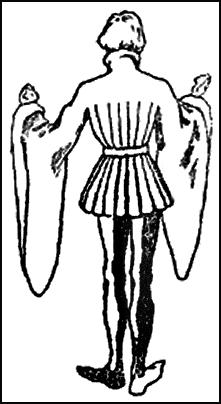
HENRY THE FIFTH
Reigned nine years: 1413-1422. Born 1388. Married, 1420, Katherine of France.
THE MEN
I think I may call this a transitional period of clothes, for it contains the ragged ends of the time of Richard II, and the old clothes of the time of Henry IV, and it contains the germs of a definite fashion, a marked change which came out of the chrysalis stage, and showed itself in the prosperous butterflies of the sixth Henry's time. We retain the houppelande, its curtailments, its exaggerations, its high and low collar, its plain or jagged sleeves. We retain the long hair, which 'busheth pleasauntlie,' and the short hair of the previous reign. Also we see the new ideas for the priest-cropped hair and the roundlet hat. I speak of the men only.It was as if, in the press of French affairs, man had but time to ransack his grandfather's and his father's chests, and from thence to pull out a garment or two at a venture. If the garment was a little worn in the upper part of the sleeve, he had a slash made there, and embroidered it round.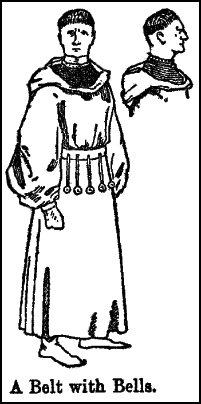
Priest Cropped Hair & A Baldrick - A Belt with Bells
If the baldrick hung with bells was worn out in parts, he cut those pieces away and turned the baldrick into a belt. If the skirts of the houppelande were sadly frayed at the edge, enter Scissors again to cut them off short; perhaps the sleeves were good - well, leave them on; perhaps the skirts were good and the sleeves soiled - well, cut out the sleeves and pop in some of his father's bag sleeves.Harfleur - Agincourt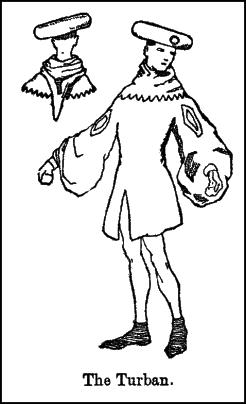
Mind you, my honest gentleman had trouble brewing: no sooner had he left the wars in Normandy and Guienne than the siege of Harfleur loomed to his vision, and after that Agincourt - Agincourt, where unarmoured men prevailed over mailed knights at the odds of six to one; Agincourt, where archers beat the great knights of France on open ground! Hear them hammer on the French armour with their steel mallets, while the Frenchmen, weighed down with their armour, sank knee-deep in the mud - where we lost 100 men, against the French loss of 10,000!
Henry V at Le Havre
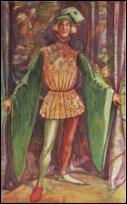
See the port of Le Havre, with the English army landed there - Henry in his full-sleeved gown, his hair cropped close and shaven round his head from his neck to an inch above his ears, buskins on his feet, for he wore buskins in preference to long boots or pointed shoes. The ships in the harbour are painted in gay colours - red, blue, in stripes, in squares; the sails are sewn with armorial bearings or some device. Some of our gentlemen are wearing open houppelandes over their armour; some wear the stuffed turban on their heads, with a jewelled brooch stuck in it; some wear the sugar-bag cap, which falls to one side; some are hooded, others wear peaked hats. One hears, 'By halidom!' I wonder if all the many, many people who have hastily written historical novels of this age, and have peppered them with 'By halidoms,' knew that 'By halidom' means 'By the relics of the saints,' and that an 'harlote' means a man who was a buffoon who told ribald stories?A MAN OF THE TIME OF HENRY V - 1413-1422
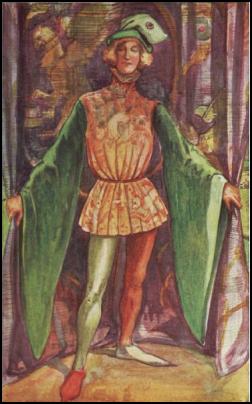 Right - The man - a 'dandy' of the Henry V era wears a short skirted houppelande with long flowing sleeves. His legs are covered with two coloured hose and his shorts are also of two different colours. Notice the sugar-bag cap with a jewel stuck in it. Heraldic surface decoration enriches the material which in medieval times was always known as stuff - good stuff being the best fabric available.
The Turban
Still, among all these gentlemen, clothed, as it were, second-hand, we have the fine fellow, the dandy - he to whom dress is a religion, to whom stuffs are sonnets, cuts are lyrical, and tailors are the poets of their age. Such a man will have his tunic neatly pleated, rejecting the chance folds of the easy-fitting houppelande, the folds of which were determined by the buckling of the belt. His folds will be regular and precise, his collar will be very stiff, with a rolled top; his hose will be of two colours, one to each leg, or parti-coloured. His shoes will match his hose, and be of two colours; his turban hat will be cocked at a jaunty angle; his sleeves will be of a monstrous length and width. He will hang a chain about his neck, and load his fingers with rings. A fellow to him, one of his own kidney, will wear the skirt of his tunic a little longer, and will cause it to be cut up the middle; his sleeves will not be pendant, like drooping wings, but will be swollen like full-blown bagpipes. An inner sleeve, very finely embroidered, will peep under the upper cuff.The Sugar-bag Cap & A Hood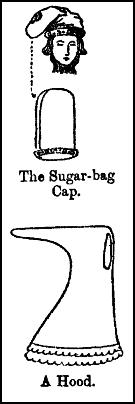
His collar is done away with, but he wears a little hood with cut edges about his neck; his hair is cropped in the new manner, like a priest's without a tonsure; his hat is of the queer sugar-bag shape, and it flops in a drowsy elegance over the stuffed brim.
As for his shoes, they are two fingers long beyond his toes.
We shall see the fashions of the two past reigns hopelessly garbled, cobbled, and stitched together; a sleeve from one, a skirt from another. Men-at-arms in short tunics of leather and quilted waistcoats to wear under their half-armour; beggars in fashions dating from the eleventh century; a great mass of people in undistinguishable attire, looking mostly like voluminous cloaks on spindle legs, or mere bundles of drapery; here and there a sober gentleman in a houppelande of the simplest kind, with wide skirts reaching to his feet, and the belt with the long tongue about his middle.
Heraldic Images
The patterns upon the dresses of these people are heraldry contortions - heraldic beasts intertwined in screws and twists of conventional foliage, griffins and black dogs held by floral chains to architectural branches, martlets and salamanders struggling in grotesque bushes, or very elaborate geometrical patterned stuffs. There is a picture of the Middle Ages which was written by Langland in 'Piers the Plowman' - a picture of an alehouse, where Peronelle of Flanders and Clarice of Cockeslane sit with the hangman of Tyburn and a dozen others. It is a picture of the fourteenth century, but it holds good until the time of Henry VIII, when Skelton, his tutor, describes just such another tavern on the highroad, where some bring wedding-rings to pay their scot of ale, and 'Some bryngeth her husband's hood Because the ale is good.' Both accounts are gems of description, both full of that rich, happy, Gothic flavour, that sense of impressionist portraiture, of broad humour, which distinguishes the drawings in the Loutrell Psalter. I feel now as if I might be accused of being interesting and of overlaying my history with too much side comment, and I am well aware that convention demands that such books as this shall be as dull as possible; then shall the vulgar rejoice, because they have been trained to believe that dullness and knowledge snore in each other's arms. However wholeheartedly you may set about writing a list of clothes attributable to certain dates, there will crop up spirits of the age, who blur the edges of the dates, and give a lifelike semblance to them which carries the facts into the sphere of fiction, and fiction was ever on the side of truth. No story has ever been invented by man but it has been beaten out of time by Nature and the police-courts; no romance has been penned so intricate but fact will supply a more surprising twist to life. But, whereas facts are of necessity bald and naked things, fiction, which is the wardrobe of fact, will clothe truth in more accustomed guise.Cloaks
I put before you some true facts of the clothes of this time, clothed in a little coat of facts put fictionally. I write the word 'cloak'; describe to you that such people wore circular cloaks split at one or both sides, on one side to the neck, on the other below the shoulder; of semicircular cloaks, of square cloaks, of oblong cloaks, all of which were worn (I speak of these, and you may cut them out with some thought); but I wish to do more than that - I wish to give you a gleam of the spirit in which the cloaks were worn. A cloak will partake of the very soul and conscience of its owner; become draggle-tailed, flaunting, effeminate, masterful, pompous, or dignified. Trousers, I think, of all the garments of men, fail most to show the state of his soul; they merely proclaim the qualities of his purse. Cloaks give most the true man, and after that there is much in the cock of a hat and the conduct of a cane. In later days one might tell what manner of man had called to find you away if he chanced to leave his snuff-box behind. This reasoning is not finicky, but very profound; accept it in the right spirit. Now, one more picture of the age. The rich man at home, dressed, as I say, in his father's finery, with some vague additions of his own, has acquired a sense of luxury. He prefers to dine alone, in a room with a chimney and a fire in it. He can see through a window in the wall by his side into the hall, where his more patriarchal forebears loved to take their meals. The soiled rushes are being swept away, and fresh herbs and rushes strewn in their place; on these mattresses will in their turn be placed, on which his household presently will lay them down to sleep.§
THE WOMEN
Every time I write the heading 'The Women' to such chapters as these, I feel that such threadbare cloak of chivalry as I may pin about my shoulders is in danger of slipping off. Should I write 'The Ladies'? But although all ladies are women, not all women are ladies, and as it is far finer to be a sweet woman than a great dame, I will adhere to my original heading, 'The Women.' However, in the remote ages of which I now write, the ladies were dressed and the women wore clothes, which is a subtle distinction. I dare not bring my reasoning up to the present day. As I said in my last chapter, this was an age of medley - of this and that wardrobe flung open, and old fashions renovated or carried on. Fashion, that elusive goddess, changes her moods and modes with such a quiet swiftness that she leaves us breathless and far behind, with a bundle of silks and velvets in our arms. How is a fashion born? Who mothers it? Who nurses it to fame, and in whose arms does it die? High collar, low collar, short hair, long hair, boot, buskin, shoe - who wore you first? Who last condemned you to the World's Great Rag Market of Forgotten Fads? Now this, I have said, was a transitional age, but I cannot begin to say who was the first great dame to crown her head with horns, and who the last to forsake the jewelled caul. It is only on rare occasions that the decisive step can be traced to any one person or group of persons: Charles II, and his frock-coat, Brummell and his starched stock, are finger-posts on Fashion's highroad, but they are not quite true guides. Charles was recommended to the coat, and I think the mist of soap and warm water that enshrines Brummell as the Apostle of Cleanliness blurs also the mirror of truth. It does not much matter. No doubt - and here there will be readers the first to correct me and the last to see my point - there are persons living full of curious knowledge who, diving yet more deeply into the dusty crevices of history, could point a finger at the man who first cut his hair in the early fifteenth-century manner, and could write you the name and the dignities of the lady who first crowned her fair head with horns. For myself, I begin with certainty at Adam and the fig-leaf, and after that I plunge into the world's wardrobe in hopes.A Woman's Caul Headress
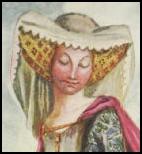 Certain it is that in this reign the close caul grew out of all decent proportions, and swelled into every form of excrescence and protuberance, until in the reign of Henry VI, it towered above the heads of the ladies, and dwarfed the stature of the men.
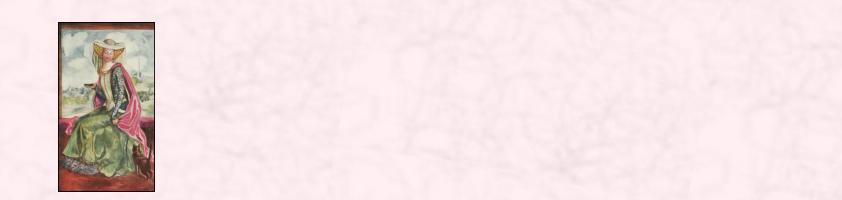
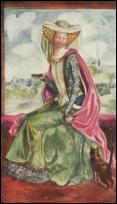
A WOMAN OF THE TIME OF HENRY V - 1413-1422
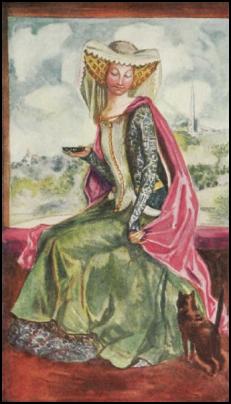 Her surcoat is stiffened in front with fur and shaped with a band of metal. Her belt is low on the hips of the under-dress. The horns on her head carry the large linen wimple.
Trains on Houppleandes
All the dresses have trains, very full trains, which sweep the ground, and those readers who wish to make such garments must remember to be very generous over the material.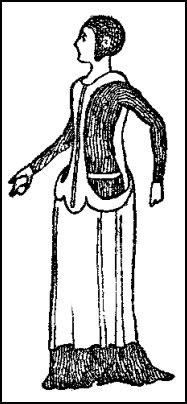
NOTE
As there is so little real change, for drawings of women's dress see the numerous drawings in previous chapter. HENRY THE FIFTH Reigned nine years: 1413-1422. Born 1388. Married, 1420, Katherine of France.This costume history information consists of Pages 161-175 of the chapter on 15th century dress in the 9 year reign of King Henry The Fifth 1413-1422 and taken from English Costume by Dion Clayton Calthrop.
- Costume History Home
- Introduction to English Costume by Calthrop
- 1066-1216 Norman
- 1272-1485 Plantagenet
- 1216-1272 Henry III
- 1066-1272 Peasants' Costume - End of the Fourteenth Century
- 1272-1307 Edward I
- 1307-1327 Edward II
- 1327-1377 Edward III
- 1377-1399 Richard II
- 1399-1413 Henry IV
- 1400 Chaucer's Medieval Dress
- 1413-1422 Henry V
- 1422-1461 Henry VI
- 1461-1483 Edward IV
- 1483-1485 Richard III
- 1485-1603 Tudor
- 1603-1714 Stuart
- 1603-1830 Hanover
- Chambre Syndicale
- Theories of Fashion