By Pauline Weston Thomas for Fashion-Era.com
- A Woman's Place is in the Home
- A Woman's Qualities
- Mistresses for Men
- Married Woman's Property Act 1887
- Social Differences Between Classes of Women
A Woman's Place is in The Home
The Victorian era seems like another world to us. Yet the late Victorians were very familiar with many of the things we use every day. The one thing that was different was the place of women in society.
There were of course perceptive women of independent original thought, but for the huge majority, life was easier if they accepted that a woman's place was in the home. To lump all women of the Victorian era as one body would be wrong.
The era spanned 64 years and changes in attitudes were gradually shifting as the century closed.
Above in the heading, we see a picture of the young Queen Victoria at 18. If you look at her in the top page of the Victorian Era you will see how she changed with the years.
Whether or not you agree with the facts today, the attitude of men toward women in the Victorian age was highlighted by Tennyson who wrote of women staying by the hearth with their needles whilst men wielded their swords.
Victorian Era Woman's Qualities

The accepted reasoning was that the career for women was marriage. To get ready for courtship and marriage a girl was groomed like a racehorse. In addition to being able to sing, play an instrument and speak a little French or Italian, the qualities a young Victorian gentlewoman needed, were to be innocent, virtuous, biddable, dutiful and be ignorant of intellectual opinion.
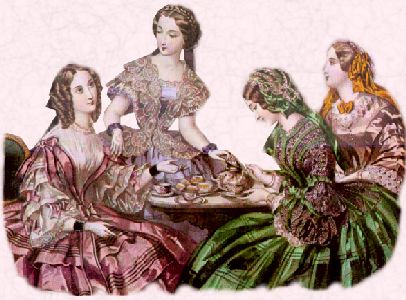
Right - Taking tea wearing lavish Victorian gowns in 1854. Fashion history images we see today are usually of beautifully gowned women, yet many working women as opposed to ladies such as these wore rags.
The dresses show typical excessive style elements such as V waists, layering of trims, bell sleeves and engageantes.
Whether married or single all Victorian women were expected to be weak and helpless, a fragile delicate flower incapable of making decisions beyond selecting the menu and ensuring her many children were taught moral values.
A gentlewoman ensured that the home was a place of comfort for her husband and family from the stresses of Industrial Britain.
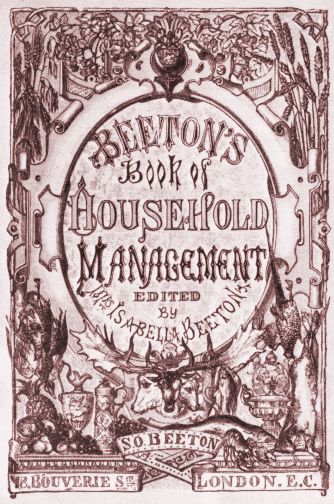
Right Beeton's Book of Household Management edited by Mrs. Isabella Beeton.
A woman's prime use was to bear a large family and maintain a smooth family atmosphere where a man need not bother himself about domestic matters.

He assumed his house would run smoothly so he could get on with making money.
Mistresses for Men
Even in high places Victorian men kept mistresses, but they still expected their wives or mistresses to be faithful whatever their own misdemeanors. If a women took a lover it was not made public. If it did become public knowledge she would be cut by society. But men could amble along to one of their gentleman's clubs and always find a warm welcome.
Married Woman's Property Act 1887
It was a hypocritical period when relationships were quite artificial. Until late in the century in 1887 a married woman could own no property. Then in 1887, the Married Woman's Property Act gave women rights to own their own property.
Previously her property, frequently inherited from her family, belonged to her husband on marriage. She became the chattel of the man. During this era if a wife separated from her husband she had no rights of access to see her children. A divorced woman had no chance of acceptance in society again.
Social Differences Between Classes of Women

A wealthy wife was supposed to spend her time reading, sewing, receiving guests, going visiting, letter writing, seeing to the servants and dressing for the part as her husband's social representative.
For the very poor of Britain, things were quite different. Fifth-hand clothes were usual. Servants ate the pickings left over in a rich household.
The average poor mill worker could only afford the very inferior stuff, for example, rancid bacon, tired vegetables, green potatoes, tough old stringy meat, tainted bread, porridge, cheese, herrings or kippers.
By the end of Queen Victoria's reign, there were great differences between members of society, but the most instantly apparent difference was through the garments worn.
The Victorian head of household dressed his women to show off family wealth.
As the 19th century progressed dress became more and more lavish until clothing dripped with lace and beading as the new century dawned.
A wealthy woman's day was governed by etiquette rules that encumbered her with up to six wardrobe changes a day and the needs varied over three seasons a year. A lady changed through a wide range of clothing as occasion dictated.
Fashion history and photographic records clearly illustrate there was morning and mourning dress, walking dress, town dress, visiting dress, receiving visitors dress, traveling dress, shooting dress, golf dress, seaside dress, races dress, concert dress, opera dress, dinner and ball dress.
Fashion plates were hugely successful in this era giving ladies supposed to women visual clues on how to dress for their new found status.
Yet change was happening everywhere. Many women adopted tailor-made garments that showed their more serious concern to be recognized as thinking beings with much to offer society beyond being a social asset for a husband.
By 1900 the railway, the typewriter, telephones, the post, the camera, the sewing machine, artificial rayon fibres and the bicycle became normal for many.
For some gas, water, electricity and even the motor car were already in use.
New inventions and how to use them led to new thinking and women of all classes felt the dynamic atmosphere of change as much as men.
Reform was in the air as intellectual female thinkers began to state their cases.

Many joined the Fabian Society, a group of nonrevolutionary thinking socialists. Others sought reform for more practical dress, better education, the right to take up paid work if they wished and better employment prospects if they were poorly paid, women.
Most importantly brave women campaigned for votes for women and birth control information even though many never lived to see the changes they fought for.
You can read how to find out more about some very informed material about occupations of ordinary women on my book review page of Helena Wojtczak's publication called WOMEN OF VICTORIAN SUSSEX - Their Status, Occupations and Dealings with the Law, 1830 ~ 1870. Helena Wojtczak's latest publication. I also have some information on women seamstresses in my Edwardian section.
Here is a summary based on Victorian Women and Their Working Roles
During the Victorian era, which spanned from 1837 to 1901, women's roles and expectations were largely defined by their gender and societal norms. The era was characterized by strict gender divisions, with men being considered the breadwinners and women primarily confined to the domestic sphere. Here are some key aspects of the role of Victorian-era women:
- Domesticity: The ideal Victorian woman was expected to be a paragon of domesticity. Her main role was to create a comfortable and nurturing home for her husband and children. She was responsible for managing the household, including tasks such as cooking, cleaning, sewing, and childcare. Women were expected to be skilled in these domestic arts and maintain a well-ordered and respectable home.
- Marriage and Motherhood: Marriage was considered the primary goal for most Victorian women. Finding a suitable husband and establishing a family was seen as their ultimate purpose. Women were expected to be submissive and obedient to their husbands, and their main duty was to bear children, particularly sons, to carry on the family lineage.
- Social Etiquette and Decorum: Victorian society placed a strong emphasis on social etiquette and proper behavior. Women were expected to adhere to strict codes of conduct and display modesty, gentility, and refinement in their appearance, manners, and speech. They were also expected to adhere to various rules of social etiquette, such as proper table manners and appropriate conversation topics.
- Education and Intellectual Pursuits: Education for women during the Victorian era was limited compared to that of men. The emphasis was primarily on teaching women skills relevant to their domestic roles. However, as the era progressed, there were some advancements in women's education, particularly in the middle and upper classes. Women gained access to education in subjects like literature, music, and art, which allowed them to participate in intellectual pursuits within certain boundaries.
- Limited Employment Opportunities: Victorian women had limited opportunities for employment outside the home. The prevailing belief was that women's natural place was in the domestic sphere. However, some women from lower social classes did work in factories, mines, or as domestic servants. As the century progressed, more middle-class women became involved in charitable and philanthropic endeavors.
- Dress and Fashion: Victorian women's fashion was characterized by modesty and restraint. Women were expected to wear voluminous, floor-length dresses with tight corsets that emphasized an hourglass figure. They often wore multiple layers of undergarments and accessories, and the clothing was elaborate and restrictive, reflecting the social expectations of the time.
- Women's Rights and Activism: The Victorian era saw the emergence of the women's rights movement. Activists like Emmeline Pankhurst and Millicent Fawcett fought for women's suffrage and challenged societal norms. However, the suffrage movement gained significant momentum only towards the end of the era, and women's rights were still limited compared to today.
It's important to note that these roles and expectations were not universally experienced by all women during the Victorian era. Social class, economic status, and geographical location played significant roles in shaping the realities and opportunities available to women. Working-class women often faced different challenges and had to work outside the home to support their families, while upper-class women had more leisure time and resources.