- Fashion Designer Inspiration
- Fashion Fabric Inspiration From Manufacturers
- Tweed as a Fashion Fabric in 2004 and 2005
- Tweed Update 2013
- Tweed Origins
- Chanel's Tweed Suits
- Linton Tweeds
- British Woollen Goods in Fashion
- Harris Tweed
- 1993 Harris Tweed Act of Parliament
- Harris Tweed & The Russian Textile Market
- Examples of Tweed Fabrics
Tweed Fabric Designer Inspiration
It is often thought that designers lead with fashion ideas. But designers can be lead and be inspired too. Their inspiration comes from many sources.
Great designers have an inherent ability to seemingly invent new fashions. They often look to fashion history to reinvent fashions of the past with an original twist. They take a sleeve of 200 years ago, but put it with a totally different bodice line in fabrics never used before.
They also observe what's happening in street fashion, TV, music and movies and get inspired by visits to foreign places.
This ferments in their brain all the while so that they constantly move through stages of the design process with one idea leading to another, adjusting a sleeve here a pocket there and firing off a brand new design, some of which the public will love and some they will loathe.
Fashion Fabric Inspiration From Manufacturers
One factor which is often forgotten in all of this, is that whilst the designer often asks a manufacturer to produce a particular material for couture inspiration, the manufacturer is the one who constantly strives to experiment to produce exciting new fashion fabrics.
These new materials often use new cutting edge modern techniques and skills, to create innovative luscious materials with effects that inspire designers to utilise a particular material in a pioneering and interesting way. In recent years the trend has been to produce lighter weight fabrics in keeping with the modern way of living.
The work of dyers, colourists and woven goods manufacturers should never be underestimated. What these manufacturers are producing as sample fabrics and colours today are the ones we will see in the shops in 2 years from now made up as fashion garments.
The new tweeds we are seeing are an example of weaving manufacturers reworking old ideas of tweed with a blend of yarns perhaps not always as traditional a mix of yarns as used before.
Tweed as a Fashion Fabric in the Millennium
These 2004 tweed fashion fabric samples are ends of couture ranges from Linton Tweeds UK, (Link below). They give you an idea of typical fashion fabric tweeds currently in fashion. These fabrics were sold as end of line lengths for about £20-25 a metre. Similar materials are available in 2005.
Click thumbnails to see the textural quality and yarn slubs in the samples. They can also be used as a source of inspiration by those who have design brief projects for story boards at college. More sample pictures are on the next page on tweeds.


Coco Chanel is credited with bringing tweed to high fashion beyond utilitarian looks in the 1950s and 1960s. It really is a long time since we have seen tweed in the high street.
Today tweed as a serious fashion fabric began to trickle into the high street shops in 2003. By spring 2004 we saw more and more tweed jackets in a host of gorgeous pastel tones. People began to wear tweed jackets with jeans or trousers. This was a new lighter way of wearing tweed, that did not need matching gloves, coordinating handbag and shoes.
This tweed said fun.
Miss Marple it was not. Princess Diana's honeymoon suit it was not. This tweed said Miss Chic. In Autumn/Winter 2004/5 tweed was Miss Must-Haves most adaptable wardrobe item.
Most fashions last for about 3 years, so for those who wanted something in tweed, last autumn was the best time to get it, to get maximum wear from their purchase. Since February 2004 I have bought 5 tweed jackets (Yes I do like shopping for new things).
They were often perfect for the rather dull British summer we had last year. They were even more perfect for the early autumn days with cool mornings and fresher late afternoons. Now as spring 2005 comes along I am finding them just as useful. Tweed also looks set to be with us during autumn 2005 as many designers still used it in their recent shows, layering texture against texture, contrasting velvet tweed and chiffon to brilliant effect.
The weight of the tweed itself is often different to that worn 50 years ago. The body simply does not look so bulky in it and for many who have never worn tweed materials it seems refreshingly new. The new lighter tweed weaves in addition to wool, cashmere and mohair, use interest yarns like chenille, exotic man made lustrous yarns with colour burst knops and gimps, and Lurex strands which all help enliven the fabric texture.
This means that the new tweeds are not just for cold winters, but also that tweed is now an ideal fabric for spring through to autumn and the lighter weights perfect in winter central heating. Heavier more traditional wool tweeds are still very well suited to the outdoors and ideal as a warm layer when driving without the hampering of a full length coat. Traditional tweeds like Harris tweeds are also perfect for the equestrian look.
In 2004/5 tweed texture is set against other texture such as a ruffle trim of pleated chiffon along the edge of jacket revers or selvedge fringing inserted between seam edges of the revers, hemline and cuffs. Worn with velvet, plain flannel trousers or jeans the contrast of other materials gives major attention to the jacket.
Whether the textile is a knobbly poodle loop weave, Irish speckle tweeds, a blended or windowpane check, a puppy check, a dogstooth, houndstooth, or a herringbone tweed all will be making a statement.
By mid decade 2005 tweed jackets will have been such a strong story that it will in ten years time have its place in fashion history drawings for the noughties.
Tweed Origins
Tweed has been woven and finished in the UK for centuries. It has a long history of being one of the finest fabric materials in the world. Throughout the nineteenth and twentieth century several manufacturers and their designers have made British tweed very special, employing innovative creative skills that elevated British tweed into an art form.
The three names that immediately spring to mind when asked about this are Harris Tweed, Bernat Klein and Linton Tweeds all produced in the UK.
Tweed was originally used for country wear, and cloaks in former centuries. In the 1890s British tweed became popular when made into the 'tailor made' garments for women. These consisted of a jacket and long skirt. It was all the rage amid a new workforce of office working women.
It was functional, warm, hardwearing and could be worn with a tailored shirt blouse which was in complete contrast to the froufrou of the period 1890-1910. It said and meant business. A variation of this was the jacket with knickerbockers and worn for cycling.
Chanel's Tweed Suits
By the 1920s Coco Chanel was simplifying dress with her innovative forward-looking ideas on female clothes.
She borrowed items normally worn by men and translated them into pared down stylish female fashion. She made simple jersey suits and also tweed suits.
However, her real influence was in the 1950s and 1960s when she translated tweed into a high fashion suit that looked modern and contrasted with the fuller dress designs and over-structured suits by Dior. She actively competed against Dior to get her message of more relaxed clothes across to the public. They may not look very relaxed to the people of today, but they were a breakthrough in their time.
Chanel's suits were simply gorgeous. She used a range of tweeds and fine textured wool boucle and poodle fabrics. The collarless jackets became so associated with her name that we now refer to the style as a Chanel jacket. Inside her jackets were lined with contrast silk which was the same silk she usually used for the blouse that teamed with it.
The insides were weighted with gold chain and the buttons all stamped on the back with the Chanel symbol. Edges were trimmed with braids, velvet or ribbon. They were elegant and chic and women have continued to wear variations of them ever since.
Such tweed suits were widely copied and translated by the shop Wallis. As a young teenager I recall lusting after a Wallis fine tweed black, braid edged suit in Chanel style which was chain weighted inside the jacket.
It was lined inside with emerald green and had a matching Miss Moneypenny emerald blouse. In the sixties clothes by Wallis were the epitome of high style with many designs being made from Paris original patterns that the brand bought the right to use.
Linton Tweeds
The house of Chanel has long used tweeds and other crepes from Linton Tweeds. The market though stagnated for Lintons in the late sixties.
But in 1969 they forged ahead to change and revamp their product, to include lighter weight material, a better range of dyes and use of wonderful new textural out of the ordinary exotic yarns that enliven design. This has proved very successful particularly in Japan. Ready to wear at once improved the use of materials once restricted to couture use.
They have an international market supplying couture houses as well as Max Mara, Jigsaw, Wallis, Aquascutum, Burberry and others.
The samples above were kindly sent to me from Linton Tweeds Please note that by the time you read this, the samples are unlikely to be available as fabric lengths. But they will have alternative materials and often show at nationwide UK Creative Exhibitions.
Linton Tweeds has a fabric shop at Shaddon Mill, in Shaddongate, Carlisle, England plus refreshment facilities. For more information check out their website which details the clothes shop, the coffee shop and how you can get the most out of your visit.
British Woolen Goods in Fashion
During the Industrial revolution, Yorkshire and Scotland both became big centres for woolen goods manufacture. In the 1950s Britain was the largest exporter of wool textiles in the world and after the Second World War, woolen goods were used to help the UK export economy recover even though UK residents were deprived of the very same goods, until clothes rationing was removed.
Even though the UK textiles manufacturing sector has contracted over the years, in 2004 what remains is an important part of the UK industry. Cloth produced by mills in Yorkshire and Scotland is sought after globally by discriminating designers and purchasers.
However, the market is smaller as third world companies compete. Because traditional methods are used to produce many of the tweeds and tartans from the UK the technique produces a fabric that is unrivalled in quality in terms of texture and handle.
The last couple of decades has also seen the introduction of lighter weight woollen materials more suited to the modern world. When I think of quality British tweeds I think of Harris Tweed, Linton Tweeds and Bernat Klein Tweeds. The 3 names offer different textural qualities in tweeds that captures the word exactly.
Harris Tweed
Harris Tweed is perfect for the new equestrian fashions for autumn/ winter 2004/5. No other material looks as good made up as a traditional tailored riding or hacking jacket.
There are many producers of cloth in the, UK but the most world famous woollen cloth of all is probably the Harris Tweed. Harris tweed is made in Britain and British tweed is the finest in the world. To be precise Harris tweed can only be woven in the outer Islands off Western Scotland in the Hebrides.
In the early Victorian era in the 1840s the wife of the Laird of Harris, Lady Dunmore encouraged the local weaving economy to promote the sales and production of Harris tweed.
Usually the wool comes from mainland Scotland and is transported to the islands where it is cleaned and dyed. After it is carded and blended it is warped onto wooden frames which are sent out to individual crofters with enough yarn to fill in for the weft (woof). They weave the material according to precise Harris pattern requirements on their time-honoured Hattersley looms.
Every weaver involved has to sign the British Harris Tweed Authority agreement that they wove the yarn by hand.
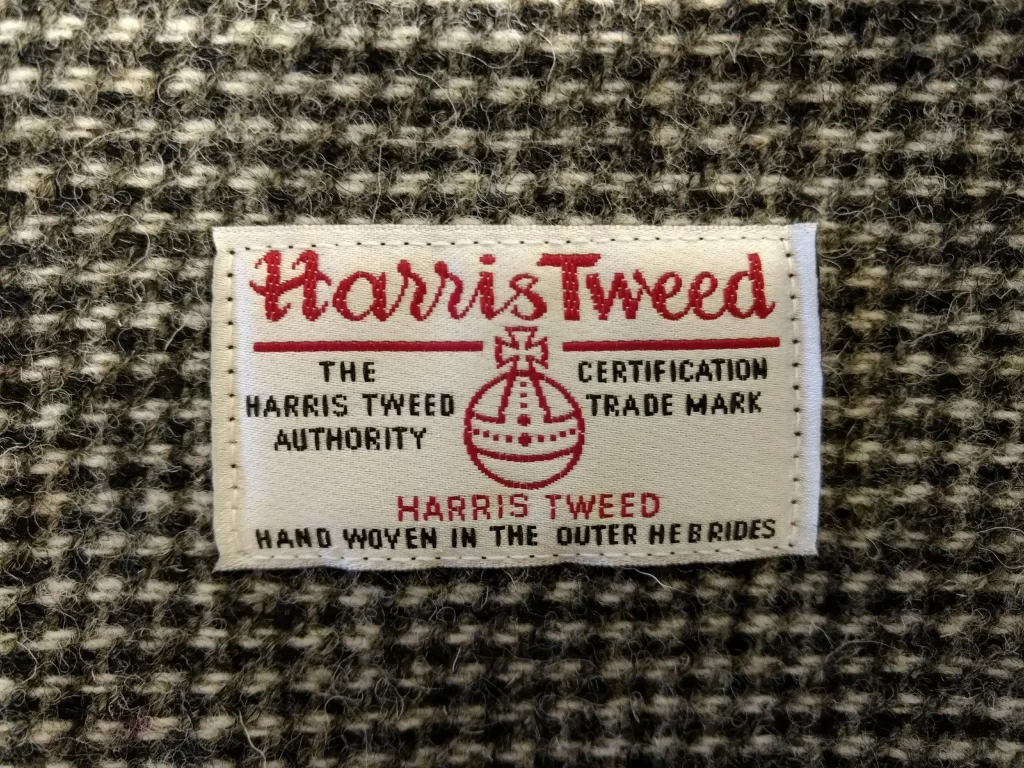
The isle of Lewis deals with finishing the cloth which includes cleaning it of the oils that kept it from splitting during weaving and then milling and cropping it, until it has the desired handle for tailoring use. The finished tweed is stamped with a certification mark to ensure it is recognized as true Harris Tweed.
The famous Harris Tweed logo and typical Harris Tweed fabrics. Note the lovely soft earthy colors and muted blues.


1993 Harris Tweed Act of Parliament
Under the legal definition by a 1993 Act of Parliament the goods must be ' hand-woven by the islanders at their homes in the Outer Hebrides, finished in the islands of Harris, Lewis, Benbecula, Uist and Barra and their several purtenances and made from pure virgin wool dyed and spun in the Outer Hebrides '.
The Harris tweed industry has taken action against competing markets and moved into the 21st century producing a new lighter weight fabric at 9oz a square metre compared to traditional weights of just over 16oz per square metre.
This is the guarantee of a genuine Harris tweed product that will have years of wear in it.
Harris Tweed & The Russian Market
I recently received this press report about Harris Tweed and which may interest some of our readers.
HARRIS TWEED HEBRIDES HITS RUSSIAN MARKET - 11 March 2010
Harris Tweed Hebrides, based at Shawbost on the Isle of Lewis, has been included in a high-powered campaign to attract Russia’s big spenders to top-end British consumer products.
The award-winning company, which accounted for 95 per cent of Harris Tweed production last year, will participate in next week’s ground-breaking event in Moscow, promoted by UKTI, the government’s trade and investment organisation. UK Showcase will feature 20 of of Britain’s leading producers of luxury goods.
HTH chairman and former UK Trade Minister, Brian Wilson, will take part in a press conference at the British Embassy in Moscow next Tuesday to launch the event.
Mr Wilson said: “It is great for Harris Tweed Hebrides to be acknowledged as one of Britain’s leading luxury brands. We are in superb company in Moscow and it is a golden opportunity to carve out a niche in the Russian market.
Russia ticks all the boxes for Harris Tweed. The climate is right for it as a fashion fabric. There is a respect for quality and heritage. And there are a lot of people who now have money to spend”.
Other famous Scottish names invited to participate are Holland and Sherry, Johnston of Elgin, and coat-makers, Mackintosh. Companies from elsewhere in the UK include Linley, the furniture design house, Dovecot Tapestries, royal glove-makers Cornelia James, and Colefax and Fowler, the wallpaper brand.
The editor of Moscow’s leading luxury goods magazine, Robb’s Report, has already visited the Shawbost mill and was hugely impressed by what he saw. Mark Hogarth, creative director of HTH, said: “The article will appear after the Moscow event and will be an ideal follow-on to the interest we expect to stimulate. There is a huge potential market for both the tweed itself and also for the products made from it.
“The exposure that we have had over the past few weeks in London, New York and Paris, with several leading designers using Harris Tweed from Shawbost, will also help to set the scene”.
Ron Archibald, head of UKTI Tradeshows, said: “From London to the Isle of Lewis, the UK is renowned for companies producing world class consumer goods. Many Russian consumers are now looking beyond the obvious labels and we are sure that the companies will find a ready audience in this discerning luxury market”.
Meanwhile, Ian Angus Mackenzie, chief executive of the company, said that orders this year are “well ahead of the same time last year” with increased demand from the United States, where Harris Tweed Hebrides have been making a marketing push, as well as big orders from Germany and Japan.
FOR FURTHER INFORMATION ON HARRIS TWEED PLEASE PHONE BRIAN WILSON 0N 01851-672274 or IAN ANGUS MACKENZIE ON 01851-702862.
Examples of Tweed Fabric
Tweed as a Fashion Fabric in 2005
Examples of couture Tweed. Note the variety of weave, color and texture of the tweed fabric, imagine how they could be tailored into suits.
These tweed fashion fabric samples are ends of couture ranges from Linton Tweeds UK 2004 range.
The chart also shows some plain samples to help fashion design students with colour schemes of coordinates. These samples give you an idea of typical fashion fabric tweeds currently in fashion. These fabrics were sold as end of line lengths for about £15-25 a metre.


Samples courtesy Linton Tweeds