By Pauline Weston Thomas for Fashion-Era.com
- Micro, Mini or Maxi 1970s Skirt Length
- Easier Travel Broadens the Fashion Mind
- Cars and Central Heating Bring Lighter Weight Clothes
- Caftan or Kaftans
- Ethnic Trends of 1970s Fashion
- 1970sAfghan Fur Trims and Cheesecloth Fabrics
- Flared Trousers, Bell Bottoms and Trouser Suits
- Platform Soled Shoes
- 1970s Tank Tops and Mix and Match Knitwear
- Fabrics and the 1970s Fashions
- Disco Dance Crazes
- 70s Disco Fashion
- 1970s Trouser Suits
Micro, Mini or Maxi 1970s Skirt Lengths


By 1970 women chose who they wanted to be and if they felt like wearing a short mini skirt one day and a maxi dress, midi skirt or hot pants the next day - that's what they did.
For eveningwear women often wore full length maxi dresses, evening trousers or glamorous halter neck catsuits. Some of the dresses oozed Motown glamour, others less so.
Left - Two young women in their early twenties on holiday in the Canary Islands c1972. The short check flared skirt was very popular, as was the empire style of the diamond check pattern mini dress. Right - Halter neck catsuit pattern of 1971. Exotic and tropical prints were a reflection of designers gaining inspiration from foreign travel destinations.

For evening in the early seventies, either straight or flared Empire line dresses with a sequined fabric bodice and exotic sleeves were the style for a dressy occasion.
One frequently worn style was the Granny dress with a high neck. Sometimes the stand neck was pie-crust frilled, or lace trimmed. Often they were made from a floral print design in a warm brushed fabric or viscose rayon crepe which draped and gathered well into empire line styles.

Another hugely successful evening style of the 1970s was the halter neck dress, either maxi or above the knee.
At a disco, girls might don hot pants. In contrast to the reveal all mini, a woman would suddenly confound men by completely covering her legs and retort that mini dresses were an exploitation, rather than a liberation of women.
Easier Travel Broadens the Fashion Mind
The influence of the self-styled hippy clothes and the mish-mash of 1970s fashion from every corner of the global village crept into mainstream fashion. Easier travel meant that people brought ideas and accessories from abroad. Others looked for designers to provide styles that fitted the mood of an era, that had returned to nature and was anti-Vietnam-war in outlook.
Cars and Central Heating Bring Lighter Weight Clothes
If travel broadens the mind, enclosed ecosystems alter the fabric options. By the late 1970s women travelling in enclosed heated cars could choose to wear lighter-weight clothes and abandon full-length coats.
Homes and stores in the temperate climate of the United Kingdom almost universally became centrally heated and most women could tolerate a chill mad dash between car and front door knowing that warmth awaited them.
Long coats gradually began to decline as an essential winter buy and a series of garments from velvet jackets, quilted padded duvet coats, hip length wool velour jackets and shaded ombre dyed raincoats, were all a more usual sight as a quick cover up from the elements.
You are reading an original fashion history 1970s article written by Pauline Weston Thomas for www.fashion-era.com ©.
Caftan or Kaftan

The Hippies of the sixties had brought with them clothes from other ethnic groupings which had often never even been seen before in the west.
Nehru jackets and loose flowing robes from hot countries made their way to world cities and permeated down to mainstream fashion, helped of course by designers like Yves St Laurent.
From the mid to late 70s, caftans, kaftans, kimonos, muumuus, djellaba (a Moroccan robe with a pointed hood) or jalabiya (a loose eastern robe) and other styles from every part of the Indian subcontinent and Africa, were translated into at home style robes and comfort wear.
They were worked in every fabric imaginable, but were especially suited as glamour dressing when sewn in exotic fabrics and edged in silver, gold or other metallic embroidered trims.
Ethnic Trends of 1970s Fashion
In the 1970s, every type of ethnic image set a trend.
A peasant fashion for eyelets with lacing, oversized ric rac braid with false bib parts of blouses became universal. Real blouses began to appear beneath short bell, or just above elbow knitwear. The lower sleeves became fuller and fuller so that by the late 1970s they were similar to Victorian engageantes. Sometimes they were left open and were known as an angel sleeve.
The edging of the sleeve was often of the bordered fabric used in the main body of the garment. Richly patterned, border print fabrics were perfect for some of the simple garment shapes of the fashion era.
The ethnic influence was so strong that it revived craft skills from far flung places. Macramé bags and bikinis from the Greek Isles and crochet waistcoats and shawls from Spain were all high fashion. The poncho was short lived and soon became a children's style.
Gypsy tops with drawn-up necklines trimmed with bells and puffed sleeves were made in cheesecloth or light cotton. In the year of 1978, Broderie Anglaise made a brief appearance as trimmed petticoat hemlines designed to show beneath peasant-style skirts.
At about the same time, Tibetan and Chinese quilted jackets and square armhole waistcoats, in mix-and-match prints were teamed with softly pleated skirts. Sometimes they had stylised patchwork print effects and were a very pretty feminine fashion.
Indian imported cotton voile dresses overprinted in gold by Phool were often worn with quilted jackets. The colours were vivid and striking bright pinks, sea greens and wonderful shades of cornflower blues. Indian silk scarves of similar designs abounded.
It was only in the 1980s when it was widely reported in newspapers that the dresses were quickly flammable, that they lost favour.
It was during the 1970s that friendship bracelets first became fashionable. These hand-braided bracelets made from coloured yarns were initially made by teenagers.
As the 1970s fashion for teaching friends how to do it flagged, street sellers started to make income from the craft by weaving bracelets to order, as customers waited. The bracelets started as fine strips no wider than 6mm, but by 2001 they were often as wide as 2cm.
1970s Afghan Fur Trims and Cheesecloth Fabrics
Foul smelling untreated bags from far flung countries began to creep into the UK. When they got damp they stank as they had not been cured properly. The same smell lingered on imported Afghan coats which were decorated and embroidered and bordered in fur. Sheepskin fur cuffs, front bands and hats with frog fastenings all gave a romantic Russian look to clothes.
The new longer clothes were made of floating and romantic fabrics that used cotton voiles and chiffons. Other fabrics such as Broderie Anglaise, tiny pink or baby blue and white checks, which had a virginal quality, all looked good in this longer fashion trend.
Cheesecloth clothes with a semi opaque quality were ideal for long peasant overtops that swung and flared away from the body hiding the waist. They followed the line of flared and bell bottom trousers.
Flared Trousers, Bell Bottoms and Trouser Suits
Trousers and trouser suits were serious fashions in the 1970s.

Pants began gently flared and reached wide bell bottom proportions by about 1975. After which they slowly reduced to straight and wide until by the end of the seventies they were finally narrow again. Popular fabrics included heavy crepes, wool jersey knits, Courtelle jersey and woven Polyester suiting such as Trevira.
Emerald green, apple green and bottle green were all favoured fashion colours of the early 1970s.
Right - Green trouser suit pattern of 1971. This style of trouser suit with a hip length tunic, was very typical of fashion trends of 1971 and 1972.
Farrah Fawcett Major and her actress colleagues of the series 'Charlie's Angels' helped popularise not only flared trousers, but also a rough cut hairstyle which demanded constant use of tongs, or heated rollers to make the hair flicks. Many women kept spare electric curling tongs or heated rollers at work, to maintain the flickups in Farrah style.
Tights sales plummeted when some women chose to wear pop socks beneath trousers. Heavy crepes used to make wide legged trousers often emulated the Chanel trousers of the 1930s. They were worn with small knitted short vests or scoop neck tank tops. Waistcoats were popular in any length from traditional, to hip length to maxi.
Platform Soled Shoes
In the early 1970s platform shoes started with a quite slim sole which moved from ¼ inch up to about 4 inches at the peak of popularity. When they were that high, individuals frequently got friendly cobblers, or handy men to hollow out cheese holes from the sole base.
A platform shoe with a 1 inch sole was quite comfortable to wear stopping the development of hard skin and feeling small stones through the soles.
By the mid seventies the most ordinary people were wearing two inch deep platforms without a second thought. But accidents did happen and many a woman and man twisted on a pair of platform shoes. At about the same time, clogs became popular as they followed the trend for chunkiness of sole.
For those who still liked to show a leg, it became tasteful in the early 70s to wear creamy white tights with black patent shoes.
1970s Fashion - Tank Tops And Mix And Match Knitwear

Really the tank top of the 70s was a forerunner to the scoop-necked camisole top of the 1980s, the shell of the 1990s and the vest of the millennium. It may be laughed at now, but it was a useful garment worn with a blouse, or simply worn blouse free with a matching V neck long style cardigan just like a modern twin set.
At the same time coordinated colour schemed clothes slowly began to enter the stores and boutiques. Suddenly it was possible to buy a skirt or trousers and top and not have to spend hours searching for tops and knits in other shops that just might coordinate with the items.
Mix and match collections of separates were soon the norm within good department stores by the 1980s.
Knitwear and knitted Raschel or jersey fabrics were the easy classic dressing of the 70s. Chunky hand knitted cardigans like the ones worn in Starsky and Hutch were soon paraded around town. The most famous designer of knitwear was Bill Gibb.
His zig zagged knit patterns and complex intricate designs in bright colours were the inspiration that was much copied by chain stores. In turn these developed into the picture knits of the 1980s and a blossoming of hand and machine knitting nationwide, primarily inspired by Kaffe Fasset an associate of Gibb.
Long knitted Dr. Who wool or acrylic scarves and matching gloves and knitted chenille turban hats were worn for winter warmth and stayed in fashion for about two years at the start of the seventies. Likewise footless leg warmers in every colour including rainbow designs were popular for two winters between 1979 and 1980.
You are reading an original fashion history 1970s article written by Pauline Weston Thomas for www.fashion-era.com ©.
Fabrics and the 1970s Fashions
Despite the fact that synthetic fabrics were used in many items of clothing there was still a great following for natural fibres. Cotton velvet and cotton corduroy in particular were worn at all hours of the day by both sexes. Coloured navy, bottle green, wine or black it could be teamed with frilled shirts or open-necked shirts.
Courtelle
Courtelle jersey was very popular for all sorts of garments from trousers suits to tank tops to neat little dresses.
From High Bulk To Low Bulk Polyester
Crimplene which had been so popular to create the correct 'A' line mini dress of the 1960s was used for every style of garment imaginable. High Bulk Crimplene began to run out of steam by the early to mid 70s and finer examples of the fabric like Lirelle had been introduced. Crimplene had been used since the 50s and was loved for its wash and wear qualities.
The ethnic influence meant that people were looking for natural fabrics or a fabric that at least looked more natural. Crimplene was abandoned and continued to be worn only by old ladies. By the 1990s it was almost extinct yet appeared to resurface in 2000 made into quality tops.
Trevira
In the 70s Crimplene was superseded by a less bulky version of polyester called Trevira. Trevira was used to make wide Bay City Roller trousers with wide square pockets down the leg sides and which were probably the inspiration of today's combat trousers.

Viscose Rayon
By the late 1970s the scene was set for the fabrics of the 80s. Fabrics like Viscose Rayon in crinkled textures were used alongside very fine crepe de chine polyester fabrics a world away from high bulk Crimplene.
Small dollybird or granny print fabrics, looked best in draping viscose rayon. The fabric enabled the full bloused sleeves to billow and hang exactly as designers intended.
Left typical dress style of the 1970s and sewn in a dolly-bird print with full bloused sleeves..
Satinised Polyesters
Satinised polyester jacquard blouses had been fashionable since the early seventies but had always been quite expensive. New technology enabled the satinised polyester to be combined with the crepe de chine to produce fabrics of great complexity which looked like real silk and which were ideally suited to the glitzy dresses of the 1980s.
Cotton
For some who took a middle line in fashion, the clothes by the designer Laura Ashley which harked back to country styles and long-lost Victorian and Edwardian summers gave them the contrast they had sought from the relentless sexuality of the mini and the exotic caftans. The fabrics were pure dress and cotton lawns with simple uncomplicated prints of yesteryear. They were a relief to many who loathed synthetic fabrics particularly in summer.
Cotton jersey emerged as a mainstay fabric for casual holiday wear. Unisex T-shirts were often tie-dyed as was cheesecloth or plain cotton.
Disco Dance Crazes - 1970s and 1980s
By the 1970s the disco scene was huge and performance dancing was popular with variations of the shake still around with Jazz tap as the new energy. Disco dance clubs created a venue for a new kind of clothing called disco wear which was based on stretch clothes and light-reflecting fabrics that shone under disco lighting.
The 80s saw break dancing, acid and house influences and a fashion for footwear such as trainers or Doc Marten shoes suited to standing bopping around all night.
70s Disco Fashion
Disco looks began in the 1970s and was memorable for its hot pants look and Spandex tops. Shiny clinging Lycra stretch disco pants in hot strident shiny colours with stretch sequin bandeau tops were often adaptations of professional modern dancewear that found itself making an impact in discos as disco dancing became serious.
Gold lame, leopard skin and stretch halter jumpsuits and white clothes that glowed in Ultra Violet lights capture the 70s Disco fashion perfectly.

Disco gave way to dress codes and a door screening policy. People had to have tried to look right to gain entry to clubs.
Disco wear was never acceptable for day wear, but for night it was the only possible wear to enable the participants to be part of the action, to be part of the atmosphere of strobe lighting, mirror balls and spotlighting of individuals at any time.
Satin jackets that reflected the light and a medallion resting on a tanned chest in an open neck shirt with the collar turned up were de rigueur, however awful such fashions might seem now.
The latter is a fashion male individuals will never admit they followed, yet for many men it was the equivalent of the iPod accessory or mobile phone of today.

Films like Saturday Night Fever of 1977 as John Travolta illustrates in the header, emphasised how important it was to release all the pent up energy of the working week on the weekend. Posing clothes designed to show off the body and made in materials like figure moulding stretch Lycra were ideal.
The elevation provided by platform-soled shoes which were the epitome of the spirit of the seventies also gave an air of theatrical space age fantasy as individuals in Lurex and satin flared silver trousers shimmered as they swayed to the music beat.
Linked to disco was the fashion for fitness and the craze to feel the burn as Jane Fonda urged in her workout videos.
Go to the section Fitness Fashion.
Disco was everything that Punk the anti fashion anarchic movement was not. Punk began as a very small movement in the late seventies and was very short-lived. It was never understood by the masses until the 80s when it had more impact as an anarchic statement on the western economy.
You have been reading an original fashion history 1970s article written by Pauline Weston Thomas for www.fashion-era.com ©.
This rememberthe70s site offers a DVD about the music of the 1970s www.rememberthe70s.com.
Punk Fashion History Development In The 1970s How aspects of Punk fashion, an anti-establishment fashion, soon became accepted as part of mainstream styling by the turn of the 21st century.
By Pauline Weston Thomas for Fashion-Era.com
This page looks at pictures of fashion designs from a 1971 dressmaking magazine.
Pictures from 1970s Pattern Fashion History
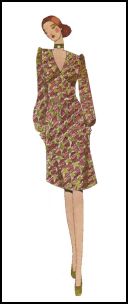
These fashion history designs are taken from some pages saved from an old dressmaking pattern magazine winter 1971/72.
The styles are a good reflection of fashion styles worn by the average woman between 1970 and 1972.
Dressmaking patterns and catalogue books are a great fashion history records of what the typical women wore.
Indeed, in the 1970s many women still enjoyed dressmaking as a hobby.
Quality dress patterns always picked up on nuances of all the latest styles.
Individuals seeking fancy dress inspiration, or those who are wardrobe assistants will find these fashion pictures invaluable guidelines.
Theatrical, carnival, re-enactment, or costume productions set in the early 1970s always need designs which realistically portray the era.
These are preferable to the extreme fashions that a limited number of people wore, and which are often used to encapsulate the era.
The 1971 dress far left has many of the elements of an early 1970s dress. It has the all important floppy bloused long sleeve, a deep 'V' neck empire line bodice, which is almost bra like in shape and a flared above-knee skirt. But best of all it's in a ditzy small print fabric so popular for granny print dresses of the era.
You could probably find a similar dress in the stores today, but what makes the picture look so 1970s, is the choker velvet band accessory at the neckline and the way the hair is styled.
1970s Shift Dresses With Focus Seams - 1971


Strong clear, primary and secondary colours were important in the 1970s.
The block-colour shift dress was a favourite that continued from the looser shapes developed in the 1960s.
However, as an A-line shape it was simple - too simple for some.
To make the style seem more novel, complex centre seams often featured a zip as a focal point, as in the red dress far left. Designers introduced yoke construction lines in no end of combinations with lines above, or below the breasts.
The yoke became an area for bold statement designer jewellery pieces. Scandinavian jewellery of the 1970s era was fresh and very forward looking with its clean modern lines.
Attention was drawn to the seam detailing by heavy use of top stitching or saddle stitching. This gave a fresh twist of 1970's individuality to dress styles.
Pinafore & Shirtwaist Styles of Dress 1971
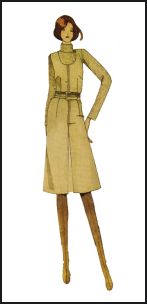
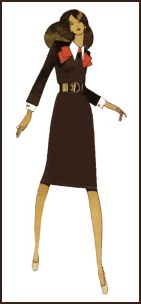
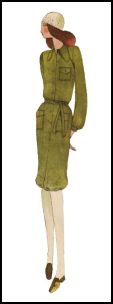
Pinafore and shirtwaist styled dresses were an everyday choice for young working girls in the early and mid 1970s.
Pinafore shift styles like this beige dress left, frequently closed with a centre front zip, or a long line of buttons.
Many of the shirt dresses with their battle dress pockets had a safari feel to them with. Shirtwaisters with long or short sleeves were accompanied by elongated long collars. In the green dress right the collar has rounded edges.
The extended collar became such a hallmark of 1970s fashions, that years later it also became a cringe factor on old clothes lurking at the back of a wardrobe.
If you are looking at costume history because you going to a 1970s fancy dress party, a close-fitting darted skinny shirt or dress with an elongated collar with rounded edges, will ensure you are hot on trend.
Other dresses of 1971/1972 had contrast white collar and cuffs. Sometimes the shirtwaisters or plain A-line shift dresses had big strongly coloured artist bows at the neckline. Red, emerald green or yellow bows were also frequently seen.
The main dress fabric was often in check material and the bow would be picked out in one of the check main colours.
1970s Flared Skirts & Bloused Sleeves - 1971


Later 1970s dress skirts were cut with flare and were A-line shaped until 1979. The skirts of all 1971 dresses even, straighter styles like the two above, had enough wearing ease for leg movement.
1971 skirts generally had flare or pleat fullness like these left and right. The inverted pleat skirt style was one of the most popular of the decade.
Bloused sleeves were a dominant fashion throughout the 1970s, but varying cuff style depths and widths kept them updated season by season.
These skirt fashion designs of 1971 are all flared and the bloused sleeves all have 2inch cuffs. Later cuffs became much longer until it was necessary to shape them to the increasing girth of the lower arm.
All of these fashion designs were worn with quite low shoes, the square block heels were about 2 or 3cm. The most interesting item shown in these 3 skirt designs is the argyle tank top right. Tank tops became a symbol of typical 1970s clothing for both women and men.
The 1970s Glamour of the Long Maxi Dress 1971

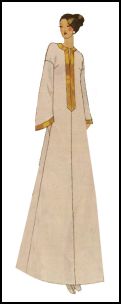
The alternative to some of the shorter dresses of the 1970s, was the long evening dress or maxi dress. Long maxi dresses were commonly worn for evening and day wear in the 1970s dependant on the woman's mood. Short dress one night, long dress the next. All in one cat suit the night after, skimpy mini dress or hot pants the night after that.
Some of the the most popular elements of the early 1970s fashions were the caftan, either full length or as a tunic top; the halter neckline and the peasant girl folkloric effect. The flowing caftan (often called a Kaftan) with generous wide sleeves and covering roominess was almost always trimmed with metallic braid, contrast fabric or gold embroidery.
Folkloric peasant styling was used with traditional Swiss/Austrian style embroidered braid finishing off garment edges. Eyelet laced belts tied up with shoelace fine ties or satin rouleaux drew on folkloric elements found not only in Europe, but also in India.
All that foreign travel, because of the availability of cheap airfares, was bringing a mixed bag of ethnic ideas into mass market fashion.
This red long dress of 1971 shown right, has a peasant style eyelet and string tie belt. The exotic tropical print was also a very strong fashion fabric of the early 1970s era. Flower power at the most striking level of design.
Halter Necklines


The halter neckline was used in all fashion clothing styles including swimwear, skimpy tops, catsuits/ jumpsuits and slinky evening gowns.
Cutaway armholes were often the most revealing part of an all-encompassing maxi dress. Skirts with splits to the thigh meant that no woman was outdone if her contemporaries had selected a shorter dress instead.
The halter top neckline resurfaced most recently as a high fashion style of autumn 2007.


The maxi skirt worn with a ruffled or frilly blouse was a very easy option in 1971. A woman bought a long skirt in velvet, crepe or courtelle jersey and then teamed it with no end of blouses. Lace was a favourite fabric for blouses and the photo above shows an ordinary woman wearing a lace blouse with long maxi skirt at a famous 1970s nightclub in south Wales, Caerphilly and called The Club Double Diamond.
The maxi cloak shown far right offered a glamorous outdoor cover up for floor length fashions.
1970s Trouser Suits - 1971
These 2 trouser suit fashion designs left were patterns on offer to dressmakers.
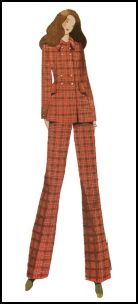
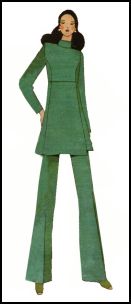
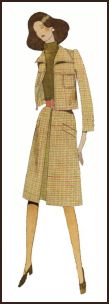
The trouser suit really established itself in the 1970s. In the 1970s trouser suits with matching jackets and trousers were considered suitable office wear. Remember that jeans were not considered suitable office wear in 1971.
The rust suit left looks quite formal to us today, but at the time it would have been considered exceptionally relaxed looking.


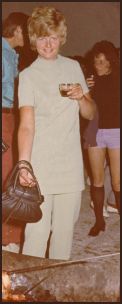
The hip-length tunic was practical and in this centre photo above taken in 1971, two girls wear contrasting fashion outfits at a barbecue in Spain. Each outfit was quite high fashion that year.
Barbara wears a sage green lightweight Crimplene trouser suit, and the woman in the background, Francesca wears hot pants. You can just see that the man has a ruffle frill on the centre front of his colourful shirt. The fashion design image of the far right print dress worn over trousers, was a more exotic feminine take on the trouser suit.
See more fashion history pictures of 1970s trousers suits below
Other alternatives for business women of the early 1970s were the tailored jacket and skirt. These two styles are representative of 1971. The inverted pleat skirt shown in both fashion patterns remained popular for years.
Page Added 3 November 2007. Ref P656.
Trousers Suits from the 70s
This section looks at pictures of fashion designs from a 1977 dressmaking magazine. The pictures in the main chart below all enlarge to when clicked and print off to A4 size.For a detailed analysis of the 1970s read the 1970s fashion history page.
See more fashion history pictures of 1977 patterns including princess styles. See more fashion history pictures of 1970s ladies skirts, maxis, coats and children's dresses. These images below are from a 1977 unbranded dressmaking pattern magazine are typical of mid seventies fashions in trouser suits. Mostly the 1970s trouser suit was made in many weights of textured or plain knit Crimplene (high bulk polyester), later Trevira (a newer polyester, but looking more like suiting), courtelle jersey knit, wool crepe, satin back crepe or linen Moygashel.
The dressmaking magazine highlighted real fashions of the 1970s and it is real costume history as many women wore it. They are a great reference for amateur dramatics costuming fashions for theatrical or costume set events of the 1970s.
The trouser suit pictures in this section of pages are typical of flared pants fashions of the early 70s as are the tunics, tabards, straight loose or flared jackets and waistcoat effects.
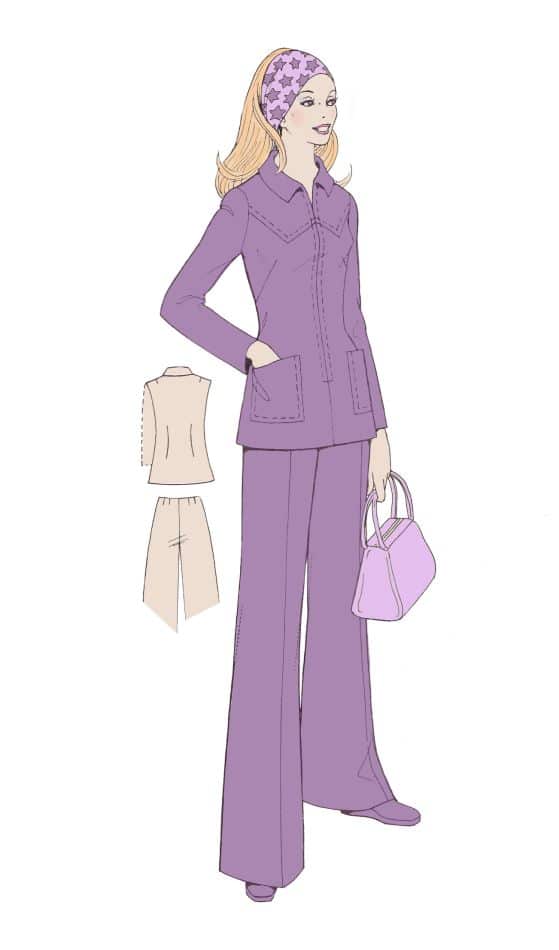
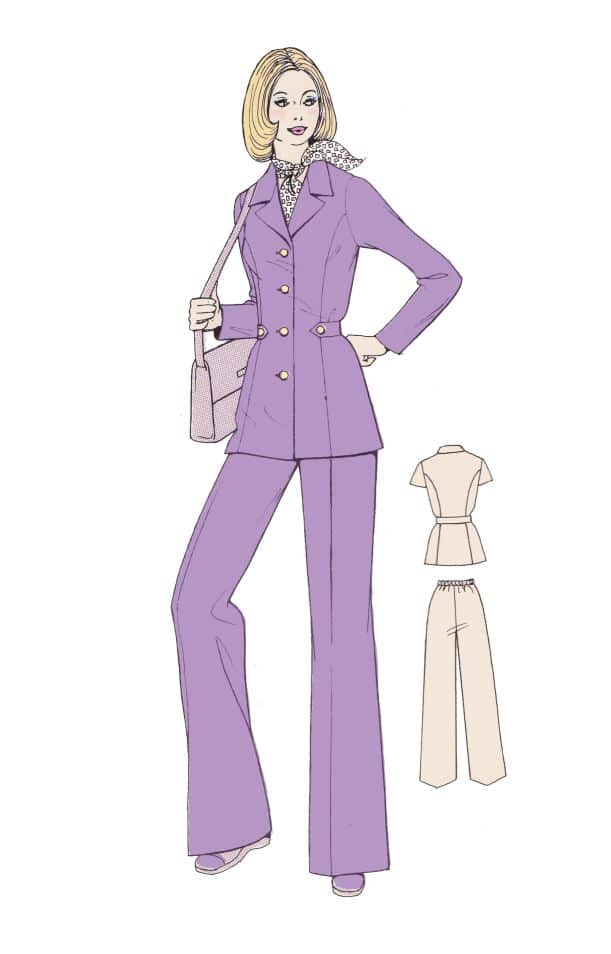
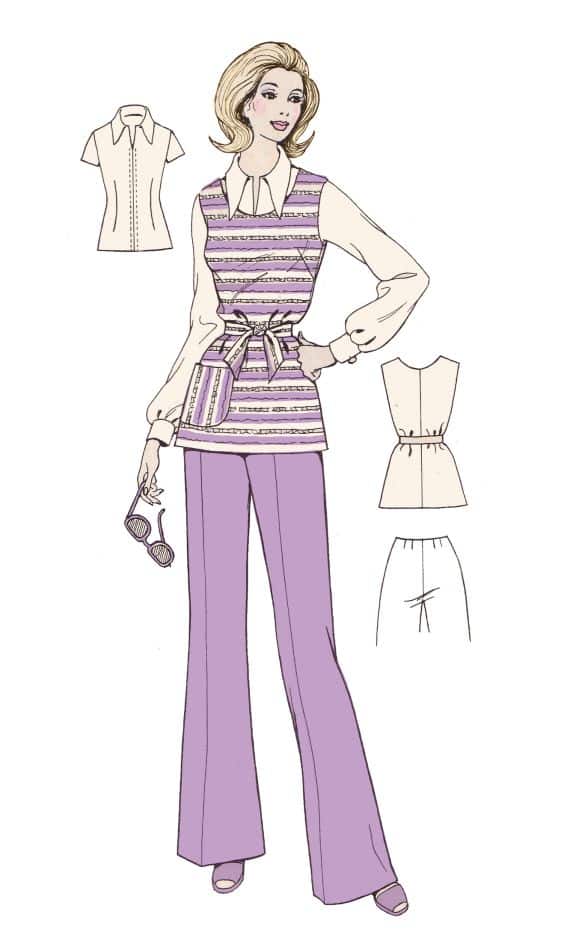


These trousers and tops above would have been considered more casual wear.
The short sleeve tunic in the far left example would have been ideal for someone working for example as a physiotherapist or lounging around. The striped tank top is a longer version of many short similar styles of tank top popular throughout the seventies.
The green princess line waistcoat might even have been worn out dancing. This waistcoat style was very popular in 1975 with both trousers and skirts. The purple tabard version on the far right is quite mumsy.


Curved shirts were also teamed with trousers too. Note how boot cut flared the trousers are by this period.


